

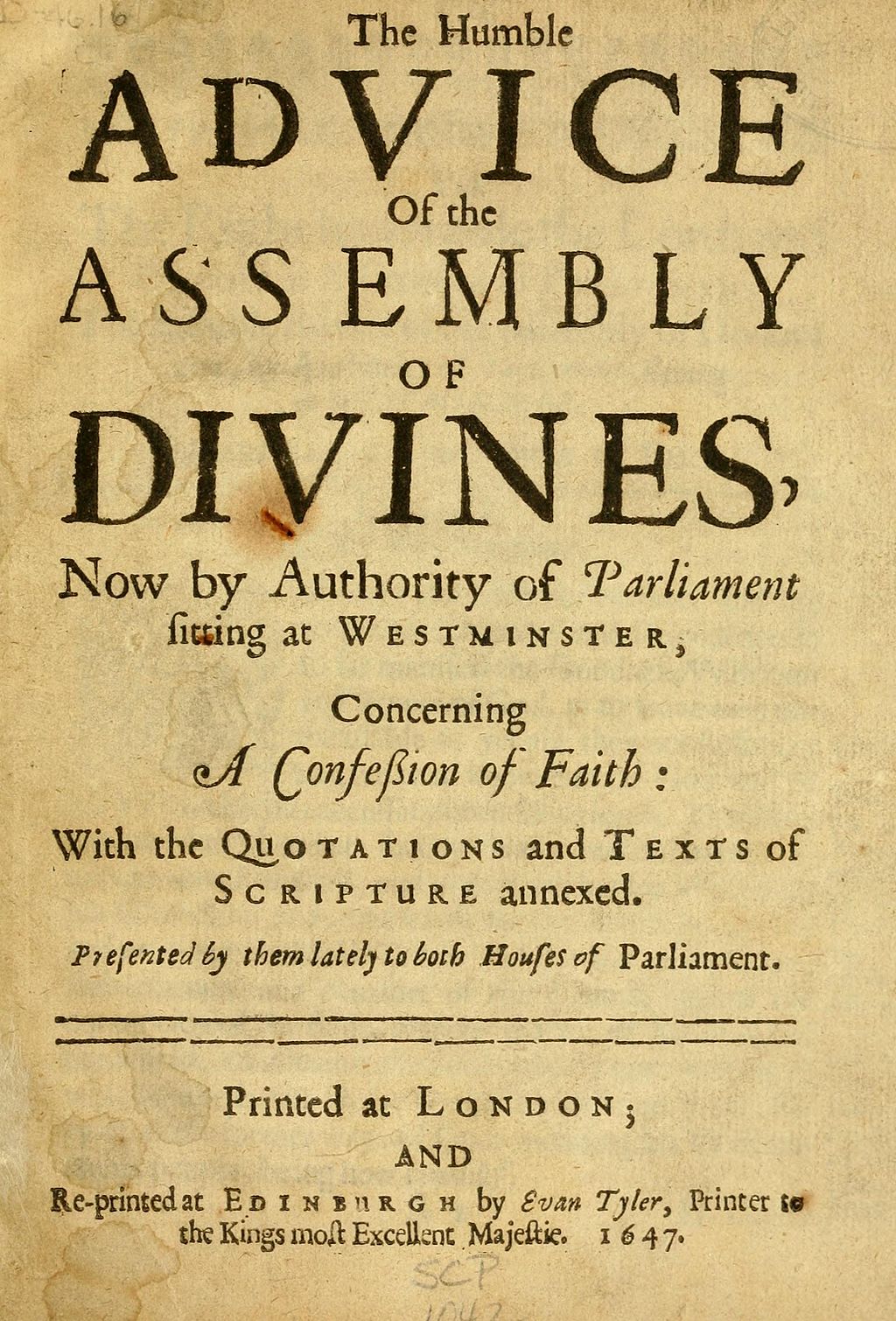
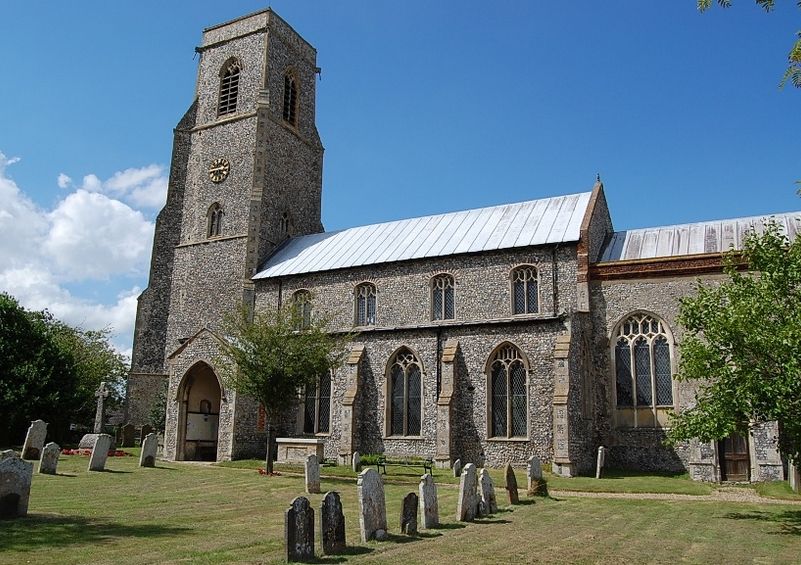
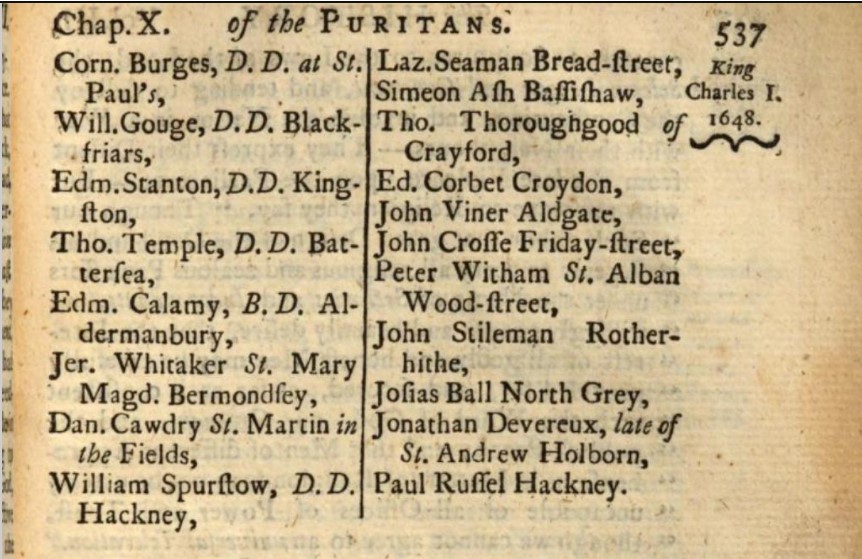
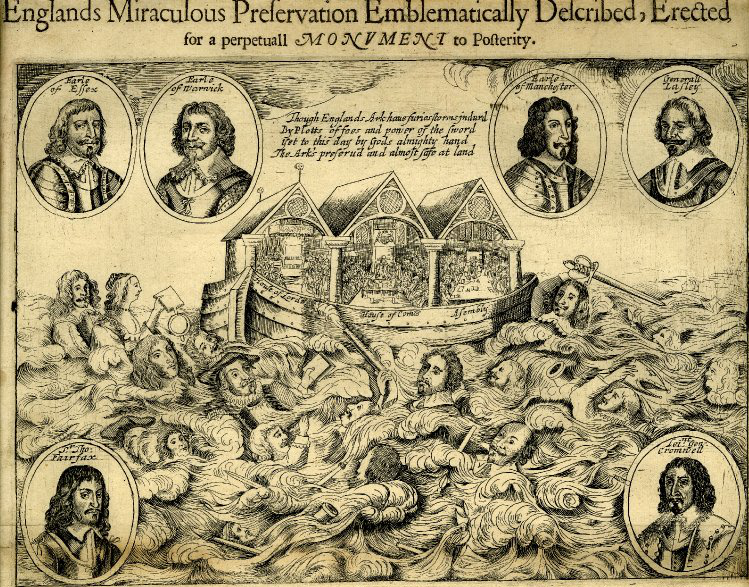
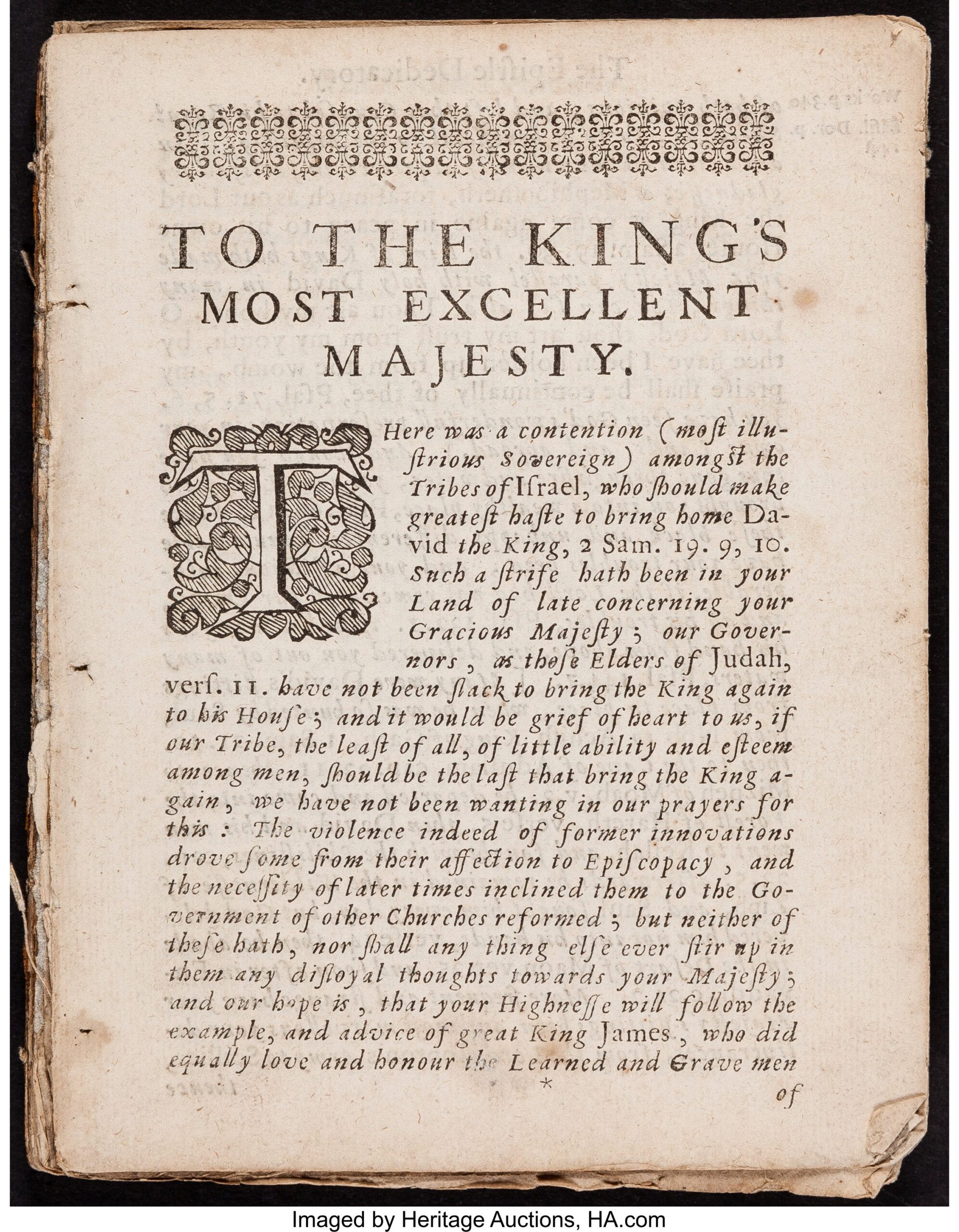
The rector board at St. Paulinus church, Crayford does not show the name of Thomas Thorowgood, who was rector from 1647 to at least 1649. His absence is explained with the words: ‘And others intruded by Parliament,’ on the board at the back of the church. Puritan Thorowgood was a member of the Westminster Assembly of Divines, who drafted their own version of the Book of Common Prayer and played a decisive role in issuing the Parliamentary Ordinance of 1644 which advocated the banning of Christmas.
Who was Reverend Thomas Thorowgood?
Thomas Thomas was born in 1588 in Grimston, Norfolk. He was the fifth son of William Thorowgood, Rector of Grimston and Bickerston in Norfolk, and a fanatical Puritan. Thomas went to St. John’s, Cambridge, taking his B.A. in 1609, and his M.A. in 1612. Afterwards, he went to Oxford, where he probably studied theology, for Cambridge awarded him his degree of S.T.B. (sacred theology) in 1624. In 1621 he became rector of Little Massingham, Norfolk, and he succeeded his father at Grimston in 1625, resigning in favour of his son-in-law in 1646. This latter decision was probably made to allow him to move closer to London, as he had been a leading member of Parliament’s Westminster Assembly of Divines since 1643.
Why did Thorowgood become Crayford’s rector?
Thomas Thorowgood does not appear on the rector board at the back of St. Paulinus church, but written sources seem to indicate that he was probably asked to fill the vacancy as Crayford rector in 1646 and took up the position in 1647. In Throwgood’s diary, he remarks on how difficult this period was in Kent:
About this time for several reasons I quitted my employment in Norfolk was invited into Kent & finding the place legally void I accepted of it & there remained till ye ruining Engagement cashiered me. ye Troubles were by then most in that County.
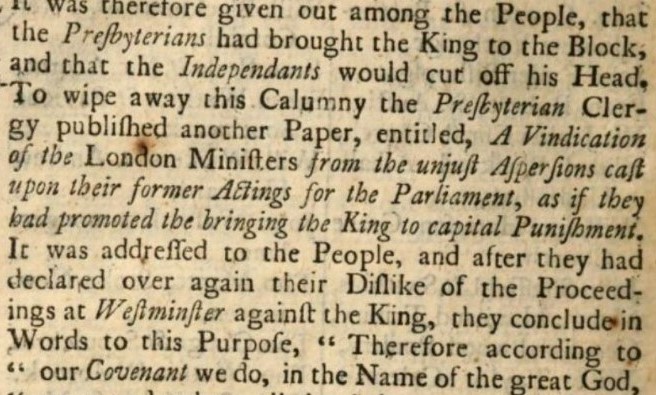
A permanent rector had not been in place since the hasty departure of Dr. Thomas Vane in 1642. Vane had secretly been converted to Catholicism at Somerset House by Queen Henrietta-Maria and her Catholic priest Father Cyprien, whilst counselling Princess Royal Mary Stuart and her betrothed Prince Willem of Orange in 1640. Vane had become very close to the French, Catholic, Queen due to his position as Chaplain Extraordinaire to King Charles I. Local Puritans had petitioned Parliament to have Vane removed from his position at Crayford. He had fled to Paris with his family in 1642 to escape arrest at the start of the Civil War and his curate Edward May had stepped into his place. May, a published poet, was popular with the people of Crayford. However, his loyalty to Dr Vane and sympathy with the Royalist cause were well known by the local Puritans, who had targeted Dr Vane. Men such as William Draper, Crayford’s Lord of the Manor, must have pushed for a permanent Puritan rector in Crayford, so in 1647 Thorowgood was appointed to take up residence in the Crayford rectory. His unhappy time here coincided with the enforcement of the Christmas ban in that year, and the Kentish protests against them that led to the Second Civil War in May/June 1648. We know that Thorowgood was still rector of Crayford in 1649, as he put his name to a petition of London area rectors opposed to the execution of Charles I. Despite this stance in favour of the King, Throwgood had already left Crayford sometime in 1649 to be assistant to the Rector of Kingston-on-Thames. Assize records from 1649 show that petty thefts took place at St Paulinus church that year, with an indictment for the theft of the pulpit cloth perhaps an indication of Thorowgood’s unpopularity amongst Crayford parishioners. Thorowgood’s own diary also refers to problems he had with the 20-30 Parliamentarian soldiers garrisoned with him during 1647-48. In his diary, he says that they took away his horse and called him a ‘Cavalier rogue.’ It seems that poor Thorowgood was accused of being a Roundhead by his parishioners and a Cavalier by the soldiers garrisoned in Crayford. Perhaps he genuinely was the moderate that he makes a claim to in the title of his diary. His temporary position in Kingston seems to have allowed him to escape this Crayford vice that was squeezing him from both sides. He possibly left Crayford after the rebellion of 1648, as his diary refers to the terrible time he had in the town, where he probably had trouble obtaining his tithe rights from the popular Edward May. His time in Crayford left him broke and desperate to leave:
My great losses in Kent are certified by two men of Crayford by whom I have never had recompense
Could one of the men he refers to in his diary be the Royalist rebel curate Edward May? He does seem to hint that he was accused of betraying local men as Royalists to the Kent Sequestration Committee, that Crayford’s Lord of the Manor William Draper sat on. Could this have been a factor in why he was forced to leave his position to take a role merely as an assistant in Kingston? There must have been a reason why his name was left off of the rector board. Betraying the popular Edward May would have left a lasting bitterness towards him, that could explain his absence from the board. Thorowgood felt it necessary to defend himself in his diary and deny that he had betrayed anyone:
No man can say I was at any time instrumental to the molestation or sequestering of anyone, and neither did I ever directly or indirectly go about to invade or possess the Title or Interest of any.
Thorowgood spent three years in Kingston. During his time there, he was accused of having Royalist sympathies because he had put his name to the petition to save King Charles I from execution. He was probably mightily relieved to return home to Norfolk in 1653, where he took up a position as rector at Great Cressingham. Once safely home in Norfolk, he felt confident enough to justify his actions in the Civil War by writing a diary, which gives us an insight into these troubled years. This together with the publication of his Christmas Day, 1644, sermon to the House of Commons, ‘Moderation Justified’[1]-and his extraordinary theory linking native Americans to the lost tribes of Israel (Jews in America, or Probabilities {that Americans are of that Race 1650) give some indication of who he was as an individual and what his motivations were during the Civil War.
Why was Thorowgood in favour of a Christmas Ban?
Thorowgood grew up suspicious of Christmas celebrations because of the ‘Godly’ or Puritan influence of his father William. From an early age, Thomas was taught that such festivities were too closely associated with Catholicism. He had been born in 1588, the year of the defeat of the Spanish Armada and at the age of seventeen had been at University when the Gunpowder Plot had been discovered in 1605. His Puritan childhood and adolescence years would have been shaped by these events. This was a time when Catholics were at best regarded with suspicion and; at worst hated and persecuted. Puritans like Thorowgood objected to Christmas celebrations as there was no mention of such things in the Bible, and therefore couldn’t be justified as they were not rooted in scripture.
Many of the strictest Puritans in 17th century England lived in Norfolk. Their strong Puritan faith was influenced by the earlier influx of Protestant refugees (the Huguenots), who fled there from religious persecution in France and the Low Countries. They felt that the Christmas festivities had simply become too drunken and debauched. Many decided to emigrate to the New World, where they could follow their Puritan ideology with no interference from the crown. Adam Thorowgood, Thomas’s brother, had decided to take this route by emigrating to New England. We know Thomas envied the fact he could live a life along strict Puritan principles, without having to compromise any of his beliefs by subscribing to the Anglican Book of Common Prayer. As one of those who remained in England, Thomas dedicated himself to bringing about change here.
How was Thorowgood involved in instigating the Christmas Ban?
In January 1642 a bill was passed by Parliament and signed off by King Charles, legislating for a monthly day of prayer, repentance and fasting. We know that Thorowgood was a great supporter of this initiative. As with many of his fellow Puritans, he believed that when times were hard the people of England would need to seek God’s intervention. This divine intervention could be brought on by seeking God’s favour through prayer and fasting. Under the 1642 law in England and Wales, the last Wednesday of every month was to be set aside for such a purpose. Thorowgood’s own writing shows that he believed in English exceptionalism, that the English were God’s chosen people and could expect God to intercede on their behalf if they proved themselves worthy of his generosity. In the preface to Thomas Thorowgood’s 1650 book, ‘Jewes in America, or, Probabilities that the Americans are of that race’ Throwgood wrote:
Britain has won [sic] the gospel glory from all other countries… it was the first of all the provinces that established Christianity by law… our Lucius was the first Christian king… our K. Henry the Eight was the first of all princes who brake that yoke of Antichrist.
This quote reveals Throwgood’s confidence in a nation blessed by God and leading the world of Christendom. It is easy to see how Thorowgood would see a Christmas ban as setting an example to the rest of the Christian world. For him England was an elect nation; a new Israel leading the world into a (Protestant) utopia.
Thomas Thorowgood and the Westminster Assembly of Divines
In April 1642, Parliament authorized the calling of an Anglo-Scottish synod of “divines” to revise the prayer book (rejecting the Anglican Common Book of Prayer) and decide matters regarding acceptable church liturgy, practices, and governance. Invited were 121 ordained ministers, 10 peers, 20 MPs as lay assessors, and 8 Scots (5 clerics and 3 laymen). The Assembly opened on July 1, 1643, at Westminster and continued until 1653. No Anglican ministers were appointed. Thomas Thorowgood was one of two selected to represent Norfolk, and he served from 1643 until 1649. The latter two years of his time on the assembly coincided with his time as rector of Crayford. In 1646, the Assembly published a New Confession of Faith based on Calvinistic doctrine and prescribed a Presbyterian form of church governance. Although the church in Scotland continued to employ the Westminster Assembly’s standards, they were revoked in England in 1660 when the Anglican Church was reinstated with the restoration of Charles II. Thorowgood discussed in his diary for 1643 how he was called to Westminster at a time when he was initially suspected of having Royalist sympathies:
But Providence called me from that mischief to the Assembly to which when I was named, one Parliament man opposed, saying he knew I was episcopal, therefore we desire to have him, said that worthy knight who related this to me & some other passages afterwards.
1644: A Turning Point in the English Civil War
For two years, England had been overwhelmed by the Civil War, torn between Royalists who supported King Charles I, who believed in the Divine Right of Kings and Roundhead Puritans, who sought to increase the powers of Parliament. These opposing forces were most fractured on matters of religion. In 1644, Thomas Thorowgood still hoped there could be a reconciliation between the two sides. He ended his address to Parliament on Christmas Day 1644 with an appeal for moderation:
Let us of this Nation pray, pray that God would return the Head to the Body, the King to the Parliament; that He will heal our breaches, compose our differences, and hasten the restoration of a safe and well-grounded Peace…
He wanted to see King Charles agree to a church organised along Presbyterian /Calvinist lines, with greater powers for Parliament. He did not, however, want to see an end to the monarchy.
During 1643 both the King and Parliament vied for the support of the Scots to help swing the war in their favour. Thorowgood had been willing to put his name to “The Covenant” in 1643 which required all English and Scottish citizens to subscribe to the Scottish Presbyterian version of the church that dispensed with bishops and followed Calvin’s ideas of pre-destination. Throwgood’s diary proves that he was a signatory of the Covenant:
The first appearance of difficulty there was the Covenant which I sub-signed.
The members of the Westminster Assembly knew that they had to curry favour with the Scots. The Scottish Parliament had passed a law that made celebrating Christmas illegal in 1640. Implementing a ban on Christmas in England would encourage the Scots to ally themselves with Parliament as they would see it as a strong act in support of their kirk (church). The Christmas Ordinance passed in 1644 and supported by Thomas Thorowgood was passed to ensure the continuance of Scottish support following Parliament’s victory over the King at Marston Moor on 2nd July 1644. This allowed Parliament control of Northern and Eastern England.
Another vital factor in the victory at Marston Moor was the inspired leadership of the Roundhead horse by Oliver Cromwell. He had brilliantly routed the Cavaliers with the Godly men of his Eastern Association army. These men abided by strict rules of discipline that punished those plundering, getting drunk, whoring, or swearing with severe punishments. Many of Cromwell’s recruits came from his home region, the Puritan-leaning East Anglia, where Thomas Thorowgood also came from.
The significance of Scottish help in the victory at Marston Moor persuaded Parliament to shore up this alliance by reinforcing Parliament’s Presbyterian credentials. Thus it was that they called together a meeting of clergymen, The Westminster Assembly of Divines, just before Christmas 1644. It was in these circumstances that Rev. Thorowgood found himself…
being summoned to the service…found…my lot was cast upon that very day, which the providence of heaven had designed to fall on Christmas Day.
And so it was that Crayford’s future rector found himself playing a leading role in instigating the Christmas ban of 1644. Christmas Day in 1644 coincided with Parliament’s monthly day of prayer and fasting that Thorowgood believed would encourage God to intercede in events and bring an end to the war. In his diary, he realised the impact his sermon had on those who objected to the cancellation of Christmas, but reminded them of their commitment to fasting:
I am not ignorant that one or 2 faulted me as if I had therein spoken against the Festivity of Christ’s birth for they remembered not the Royall legality of that Fast day.
Thorowgood felt that the Fast Day falling on Christmas Day was a coincidence that showed the will of God. In his diary, he highlighted this as a reason for the Parliamentary Ordinance banning Christmas to be adhered to:
The providence of heaven had designed the Fast to fall on that day, the metropolitan of all Festivities; I have heard the same since, but when I read Math. 10. 29 & that God worketh all things according to the counsel of his own will Eph. 3. 21. I see yet no cause of such distaste. It was a good providence that guided the King & Parliament to appoint at first that day of prayer against the Irish cruelties & for ye diversion of the like from England.
To this end, Parliament issued a specific ordinance that emphasised that church services could not be carried out on Christmas Day and that shops should open as normal. Given that the ordinance was issued only a few days before Christmas, the country was torn apart by the Civil War, and Parliament did not control much of the country, it was questionable how many people carried this out. It would need victory in the First Civil War in 1646 to bring Parliament into effective control over the whole of England for the Christmas ban to take effect in 1647. By the time this happened, Thomas Thorowgood would be implementing the ban himself in Crayford and making himself very unpopular with his curate Edward May and his Royalist-leaning parishioners.
Thorowgood’s Dislike of the 12 Days of Christmas
From medieval times the Twelve Days of Christmas that concluded on 12th Night- January 6, (Epiphany) had been a celebration of joy at the darkest time of the year. 12th Night had been the focus of Stuart Christmas celebrations at the Banqueting Hall in Whitehall ever since James I had come down from Scotland to accept the crown. Whereas Christmas Day itself was dedicated to going to church the remaining days were filled with parties, dances, plays, bonfires, feasting, and drinking. People decorated their homes with evergreens, a tradition going back way before Christianity had come to England. For centuries rosemary, and holly wreaths brought some greenery in the midst of a grey mid-winter. The 12 Days of Christmas were also known for their drunken forms of entertainment directed a “Lord of Misrule.” Thorowgood and his fellow members of the Westminster Assembly of Divines felt that the focus on these celebrations was wrong. They also objected to a festival that had strong Catholic roots. The very name, ‘Christ’s Mass’ associated the festivities with what they considered to be ‘popery.’
The debate about what to do about Christmas had begun in the very early days of the English Civil War. Thomas Fuller in a sermon in 1642 bemoaned that the youth of England were:
“so addicted to their toys and Christmas sports that they will not be weaned from them,”
Thorowgood, like Fuller, wanted to see fasting and abstinence at Christmas not feasting. This was never a majority view in England. As parliament began to align itself with this harsh view of Christmas they began to put themselves at odds with the views of most of the people of England. What they proposed was ‘Turning the World upside down’ according to the Royalist Water poet John Taylor. However, by 1644 a majority of members of Parliament considered themselves to be Puritan/Presbyterian and so were prepared to impose their idea of Christmas on everyone else. Until a universal franchise elected Parliament, it was possible for a small group of religious fanatics to impose their ideas on the majority. In 17th century London this lack of democracy often led to riots amongst the London apprentices. It’s quite understandable when you consider how many ordinary folk lost their day off when the 1644 Parliamentary ordinance ordered shops to open on Christmas Day. Many chose to oppose the ordinance by continuing to decorate their homes with Christmas holly. The Reverend Nicholas Bernard would be cast into the Fleet prison for decorating St Margaret’s church, Westminster on Christmas day 1647. Puritan fasting and abstinence were never going to win the popularity war. Enforcing the 1644 only led to noncompliance and ultimately in Kent the Second Civil War. Nevertheless, Rev. Thorowgood still argued the Puritan case to ban Christmas. In his 1644 sermon, he said:
This day (Christmas), and those next it, have been heretofore the only merry season of the year, and the Devil hath been served better on those Twelve days than on all the twelve months beside; and our Master Christ hath most unchristianly by many been dishonoured, even in those days said to be devoted to his glory:…Great cause therefore had your Ordinance to command this day to be kept with more solemn humiliation, because it may call to remembrance our sins and the sins of our fore-fathers who have turned this feast, pretending the memory of Christ, into an extreme forgetfulness of him, by giving liberty to cranial and sensual delights, being contrary to the life which Christ himself led here upon earth.
Christmas was a Pagan Festival to Thorowgood
Thorowgood’s faith was solidly based on his interpretation of the English Bible. Nowhere in the New Testament was a date given for Christmas. This troubled Thorowgood and other Puritans who sought to understand why Christmas was celebrated in December. They were horrified to discover that the 25th December date was linked to the Pagan Roman Winter Solstice festivities, Sol Invictus and Saturnalia and not Christ’s actual birth date. Rev. Thorowgood was in fact more moderate than firebrand Puritans like William Prynne. He understood the need for some pragmatism:
I wish …that those heathenish, mad, and riotous usages…might be quite abandoned forever; but let the neighbourhood and charity of those times at least in some time of the year be continued; sure I am that some who had withered hands all the year …did at that season stretch them out to the poor…. If the serious disquisition of Historians and Mathematicians shall calculate and design the month & the day, I shall not vote against the Christian celebration thereof, but as at Berne when the Gospel was first reintroduced, they set their prisoners at liberty and proclaimed freedom; and we [should] observe a Day in memory of our Deliverance.
The End of the World and Thomas Thorowgood
Rev. Thorowgood saw similarities between prophesied destructions that would come upon the world prior to Christ’s return and the death and destruction of the Civil War. His work in the Westminster Assembly was driven by his belief that “the Lord is at hand.” When he arrived in Crayford in 1647, Dartford rector Vavasor Powell had just given up his position as rector of Holy Trinity Church, Dartford. Powell, was a firm believer, like Thorowgood, that the Civil War indicated that the end of the world was close. War, famine, disease and death matched the prophecy of the Book of Revelations that the Four Horses of the Apocalypse would show themselves before the World came to an end and Christ re-appeared on earth.
the Kingdoms may yet be happy in a safe and well-grounded Peace, and it is high time to hasten it, the whole Land almost is already laid waste by the Sword, which, if not speedily sheathed, is bringing upon us a worse evil unavoidably, a Famine; for they that be slain with the sword are better then they that be slain with hunger…
Famine had devastated the Bexley area at this time with court records full of stories of engrossing as people profiteered from shortages. In the year before Thorowgood arrived in Crayford, Bexley rector Nicholas Frankwell would sell the Communion silver of St Mary’s church in an effort to maintain his depleted income as tithe funds dried up.
Famine was followed by plague in 1644-45 in Crayford and Dartford. Vavasor Powell would bravely care for the sick of Dartford before departing in 1646 to join the new Model Army siege of Oxford. He believed that the defeat of the King would bring about the end of the world and that joining the New Model Army would help to hasten this. Thorowgood, it appears shared some of his millennial beliefs that the end of days had come.
The New Model Army
At the end of 1644, in an effort to realise victory in 1645, Parliament had decided to create a new efficient army. This was The New Model Army that Dartford rector Vavasor Powell would join at Oxford in 1646. In an attempt to make this new army less political, those serving in both the military and Parliament were forced to choose between those positions through the Self-Denying Ordinance. However, the army ended up with a greater representation of Independents like Cromwell than fervent Presbyterians like Thorowgood, which ultimately resulted in its own conflicts. While the New Model Army’s focus was to win battles, there was a general religious orientation, and they were issued a special Soldiers Catechism. It was also the first time there was a national uniform created for the troops which became called “redcoats.” Thorowgood welcomed these changes as he hoped and prayed for an end to a war that had devastated what he firmly believed was God’s chosen country:
O England: never since thou wert a Nation didst thou see thyself so miserably torn and rent with such uncivil, unnatural, and bloody distractions: If it had been said to any of thy people, four or five years since, that they should do such things, as are now done in the midst of thee, they would have replied with indignation….Wretched things are done by men, Christian men, Englishmen against Englishmen, professing the same Religion, protesting the same Cause and End of their quarrel: O that thou couldst yet discern those formidable clouds of blood in their scattering: but alas, they threaten worser evils, even to make thee a full sea of blood within as thou art without surrounded by water….But let all those be ashamed and astonished, prophets and people, that have not helped to quench, but kindle this fire: This is indeed a lamentation.
Thorowgood’s Defence of a Calvinist Anglican Church
Rev. Thorowgood’s sermon to Parliament on Christmas Day was so popular with the Presbyterian leaning member of Parliament that it ended up being published. Thorowgood wanted to see a uniform church of England built on Calvinist, Presbyterian lines. He was equally opposed to the high church (Laudian) Anglican church of Charles I and the ‘secretaries’ and the growing proliferation of independent religious factions closely associated with the troopers of the Roundhead New Model Army:
…new opinions suffered will devour the old, and the toleration of every Religion will destroy all Religion: and …leave no Religion at all….This liberty is inconsistent with civil tranquillity; the bleeding condition of our own Nation at present is a living, almost a dying witness of this;….This may be current doctrine among the Turks:..As a Garden is beautified with a variety of flowers, so his Empire would be adorned with diversities of religion: let such toleration find allowance in the Turks’ Paradise; it shall never, I trust, be planted in the Paradise of God (England).
Crayford’s rectors at the heart of the Civil War Clash of Ideas
‘The Warre was begun in our streets before the King or Parliament had any Armies’. Richard Baxter
Puritan Richard Baxter believed that the origins of the English Civil War could be seen in the divisions that existed in every town and village in England. Crayford’s rectors between 1642 and 1647, Dr Thomas Vane and Thomas Thorowgood prove this point. CRAY’s research has uncovered the hidden story of how Crayford’s rectors were at the centre of the Battle of Ideas during the English Civil War. We have explored elsewhere on this site how Dr Thomas Vane, as ‘Chaplain Extraordinaire’ to King Charles I, championed a Laudian high church view of the Anglican church. This article showed how his views led to him eventually converting to Catholicism at Queen Henrietta Maria’s Catholic chapel at Somerset House in 1640. The story of how he became a favourite of the Queen, but a symbol of hatred to local Dartford Puritans, is incredible. We have been genuinely surprised and thrilled to discover that his successor, Thomas Thorowgood played such a key role in the banning of Christmas in 1644. We did not know anything about Thorowgood when we applied for our Heritage grant. We now hope to add to this article further details of how Thorowgood witnessed the trial of Charles I in 1649 and how he opposed the decision to execute the King.
References:
Thorowgood, Thomas, Moderation justified, and the Lords being at hand improved,: in a sermon at Westminster before the Honorable House of Commons assembled in Parliament: preached at the late solemn fast, December 25. 1644. By Thomas Thorowgood B. of D. Rector of Grimston in the county of Norfolk: one of the Assembly of Divines. Published by order from that House (London: Christopher Meredith at the Crane in St. Paul’s Churchyard, 1645),
Thomas Thorowgood’s diary was transcribed by The Congregational Historical Society in 1925: A Puritan Moderate: DR. THOMAS THOROWGOOD, S.T.B. 1595-1669. RECTOR OF GRIMSTON, LITTLE MASSINGHAM AND GREAT CRESSINGHAM IN THE COUNTY OF NORFOLK. A PDF of this document is attached to this article.


No Comments
Add a comment about this page