

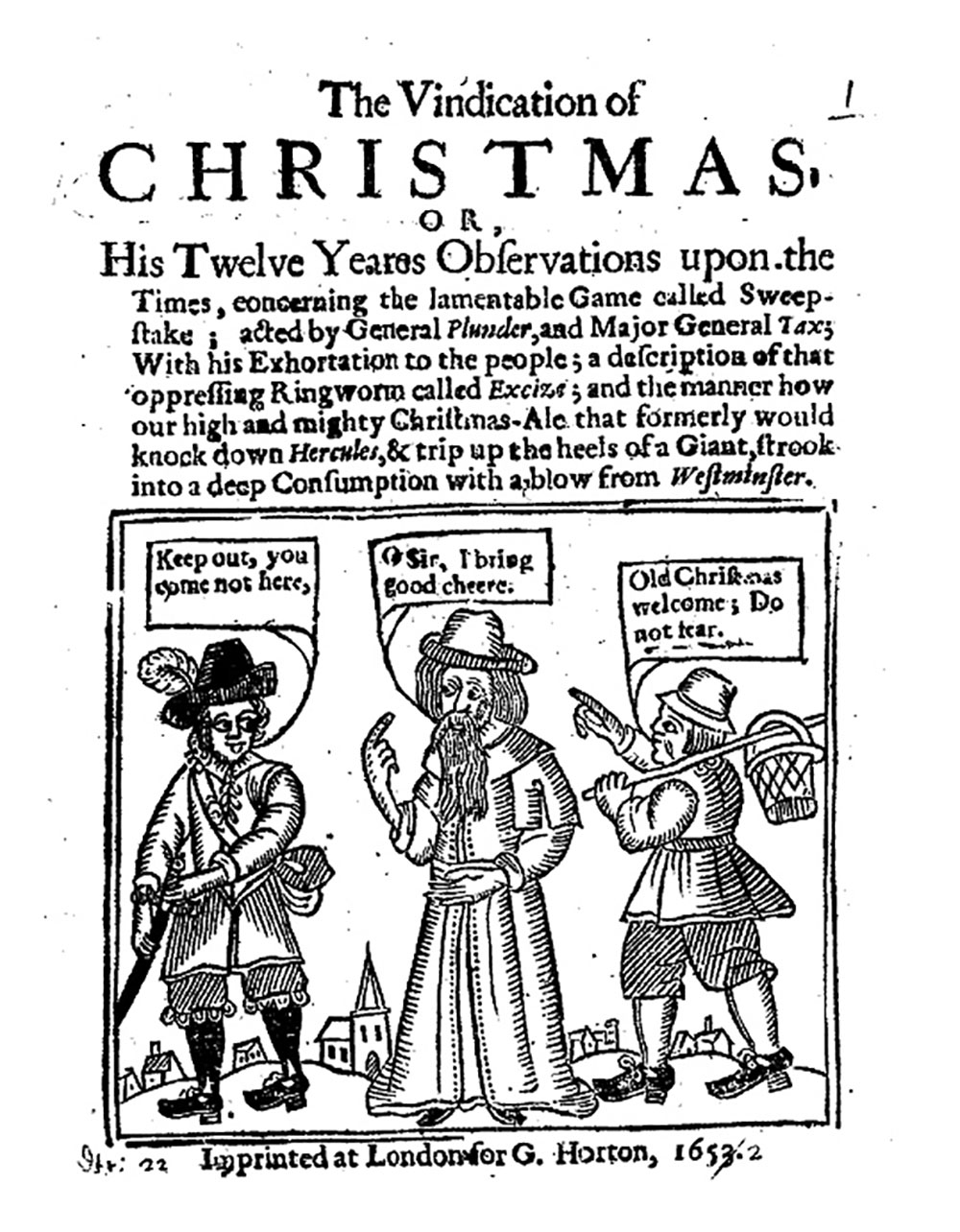
The title of our project, The Vindication of Christmas comes from a pamphlet of the same name written in 1652 by John Taylor, a Thames waterman who stood up to the Puritan assault on Christmas tradition. The cover of John Taylor’s pamphlet personified Christmas and championed the customs of the common man against what Taylor felt were the beliefs of a minority.
Taylor’s ‘The Vindication of Christmas’ argued in favour of the people’s right to celebrate Christmas with drink and games and family activities. The title page depicts a woodblock cartoon showing a sword-bearing Puritan on the left challenging a figure that can easily be seen as an early representation of Father Christmas, who is being defended by an ordinary working person on the right. Among the many things Taylor objects to are the new taxes imposed by a victorious Parliament that he casts as “General Plunder” and “Major General Tax” on things like Christmas Ale.
The Vindication of Christmas was not the first time that Taylor personified Christmas. He had been championing the festive season long before the Civil War started. In 1631 he published, The Complaint of Christmas, which told the story of Father Christmas’ visits to London, Yarmouth, Newbury and Gloucester, where he finds no sign of celebrations. A large crowd complains to him that:
All the liberty and harmless sports, with the merry gambols, dances and friscals [by] which the toiling plowswain and labourer were wont to be recreated and their spirits and hopes revived for a whole twelve months are now extinct and put out of use in such a fashion as if they never had been. Thus are the merry lords of misrule suppressed by the mad lords of bad rule at Westminster.
Who was John Taylor?
John Taylor was born on 24 August 1578 and was what was known as a waterman, ferrying people across the Thames for a fee. He had moved to London as a young man and began an apprenticeship with an experienced waterman.
This job brought him into contact with an endless sea of new faces and stories and it is here that John Taylor gained an appreciation for current events as well as the skill of crafting a tale.
Taylor’s apprenticeship ended around 1605 and during this time he began to develop an interest in literature and learning. He also made friends with many of the notable actors and playwrights of the day since the law kept all of the theatres, and other forms of entertainment, south of the river. Taylor was very closely connected with the world of the theatre, although he never attempted to write any plays himself. He was also known to have an immense appetite for books on many different subjects and soon after began to write his own works in various styles of writing.
Taylor wrote satires, verse essays, travel writing, religious reflections, journalism, etc. His writing gives a rare glimpse into 17th-century life as well as the cultural shifts in early modern England. He was also a minor celebrity in his day when professional writing was a relatively new career.
In 1612, Taylor wrote such works as, The Sculler, Rowing from Tiber to Thames with his Boat Laden with a Hotch Potch, or Gallimawfrey Sonnets, Satires and Epigrams. These contained religious and personal satires and rhymes.
Taylor’s connections to the Crown
Taylor’s writing landed him in trouble on multiple occasions. There were many documented occasions of him being charged with libel or getting mixed up in public feuds with his writing. In 1613, however, he was appointed one of the king’s watermen, which put him in direct contact with the Royal Court. The King employed around forty watermen for use in ceremonial and public occasions. John Taylor used this position to advocate for his fellow waterman as well as his friends in the theatre, which elevated his status both in the royal and literary circles.
Taylor defends Christmas in the Civil War
In 1644, Oliver Cromwell’s Parliament banned Christmas because of the growing Puritan movement in England at the time. They thought that the festivities associated with the holiday were too closely connected with Catholic superstition. Many also believed that Christmas celebrations had become too drunken and debauched.
When John Taylor heard of this, he was outraged. He equated the decline of Christmas festivities with a decline in traditional values. Taylor saw the Christmas celebrations as symbols of paternalism and social harmony. He viewed merrymaking as intrinsic to the religious significance of Christmas, not perverting it. Even the drinking that occurred, he thought did not need to be at odds with religion, but that it in fact increased feelings of fellowship and piety. Taylor viewed himself as a middle-of-the-road figure when it came to religion. His personal religious views were thought to have derived from multiple strands within the established church.
Taylor uses the Power of the Printing Press to Defend the Festive Season
Following the outbreak of the Civil War in 1642, Taylor became one of the first to hint at the possible banning of Christmas in print in 1643. In a pamphlet, he depicts a fictitious address by a lecturer preaching against the celebration of Christmas. “ it is a detestation of their blindness that has brought me hither this day, to enlighten you… and I give you to understand that the very name of Christmas is idolatrous and profane, and so, verily, are the whole 12 days [of Christmas] wherein the wicked make daily… sacrifices to riot and sensuality”. Taylor stressed the danger that Parliament and the Puritans posed to Christmas and only eight months after the pamphlet was published, his fears came true.
John Taylor then decided to publish his Complaint on Christmas, which had the same title as his 1631 pamphlet promoting the observance of the mid-winter feast. This pamphlet, however, was meant to stir mass resentment of the people against the Parliamentarians.
Taylor’s satirical pamphlet inspired a counter-satire entitled The Arraignment, Conviction and Imprisoning of Christmas published by the Parliamentarians. Published in January 1646, this pamphlet took great pleasure in conflating Taylor himself with the symbolic character of ‘old Christmas Day’ whose persona Taylor had assumed in his own pamphlets. In one paragraph, Taylor/‘old Christmas Day’ is portrayed sitting hopelessly surrounded by the king’s shrinking territories, while desperately urging “all you that ever think to see Christmas again, stick to me now close!
Taylor did not live to see the restoration of Christmas
In 1660, Christmas was restored along with the monarchy and Charles II, however, John Taylor did not live to see it as he died seven years earlier in 1653. He was buried at St Martins-in -the Fields, Westminster at a time when Christmas festivities were banned.


No Comments
Add a comment about this page