


The Reverend David Clarkson was the second Puritan rector ‘imposed by parliament’, on the parishioners of Crayford. Having driven out parliament’s first appointee, the Westminster Divine, Thomas Thorowgood, Crayfordians of a Royalist persuasion were determined that their long-time curate Edward May would move into the rectory. However, when Clarkson was appointed to become Crayford’s rector by Oliver Cromwell a mini-civil war broke out in Crayford, which resulted in, violence bitterness and litigation.
Clarkson versus May: A Crayford Civil War
Puritan Richard Baxter would claim that,
‘The Warre was begun in our streets before the King or Parliament had any Armies’.
In so many towns and villages across England, the bitterness between Roundheads and Cavaliers had been very apparent before the Civil War began in 1642. That bitterness remained after the war had ended and there is no better example of this than the clash between two of Crayford’s rectors during the Civil War period. The violence of the Civil War was resumed between Roundhead rector David Clarkson and former rector and Royalist, Edward May.
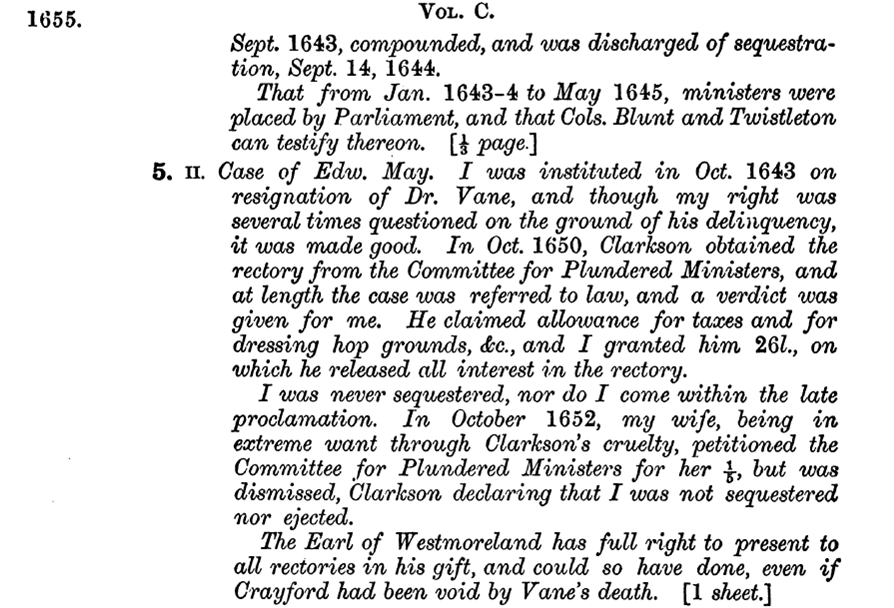
David Clarkson was appointed as rector of Crayford in 1650 to Crayford, by the Committee of Plundered Ministers in the place of Edward May, the poet curate who had served alongside Crayford’s Royalist rector Dr Thomas Vane for many years. May had stepped in to take over as rector in 1643 when Vane had been forced to flee Crayford for Paris after his conversion to Catholicism. May may have been suspected of having his own Catholic sympathies due to the publicity given to Vane’s conversion due to Vane’s close relationship with Queen Henrietta-Maria, the wife of King Charles I.
May favoured by the Earl of Westmorland
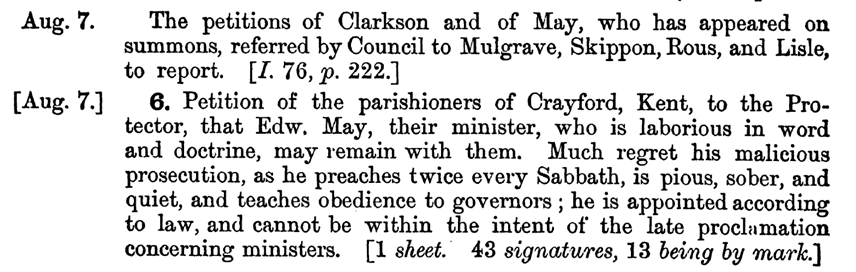
May had been recognised by Mildmay Fane, 2nd Earl of Westmorland (24 January 1602 – 12 February 1666) an influential Kentish relative of Dr Vane, who held the power to appoint the rectors of Crayford. May’s support for the failed Royalist rebellion in Kent, which culminated in the Second Civil War, led to him being removed from his position as Crayford’s rector. Thomas Thorowgood, who was imposed as Crayford’s rector by Parliament between 1647 and 1649 denied that he was behind May’s fall from grace and denouncement. May would have had little hope that he would be restored as rector in 1650, because of the influence of Parliamentarian William Draper, Crayford’s Puritan Lord of the Manor who lived at May Place. Fortunately, for May, although Draper was elected as Parliament’s Sheriff of Kent in that year, it was also the year of his death. With Draper out of the way May must have believed he stood a chance of returning to the Crayford rectory, as he had the support of forty-three local parishioners in their petition to parliament.
Clarkson’s Petition to Parliament
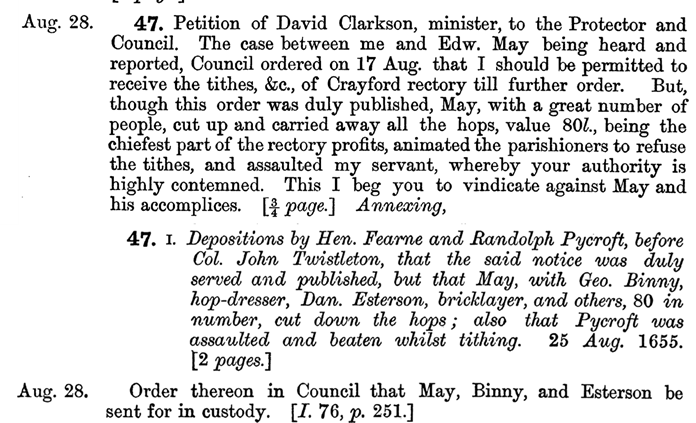
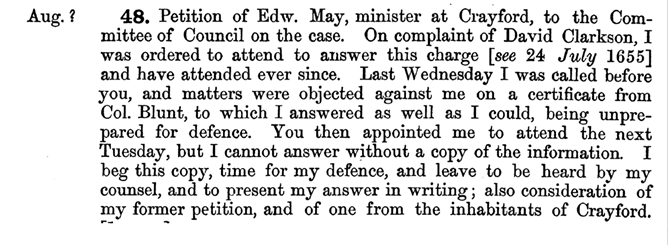
Clarkson went to the House of Commons with a petition in 1655 claiming that May had tried to regain possession of his Crayford pulpit by force. Clarkson’s petition outlined how May engaged his former Crayford parishioners to help restore to him the tithe income he had lost since Clarkson had taken possession of At Paulinus rectory. Clarkson’s petition went before Parliament on 17th August 1655. It was a counter-petition to one submitted by Edward May on 7th August.
The humble petition of David Clarkson, minister of the gospel: That the cause betwixt Mr May and your petitioner, concerning the Rectory of Crayford in Kent, being heard and reported, the honourable Council, on Friday the 17th of August, inst., ordered that your petitioner should be permitted peaceably and quietly to receive the tithe and profits of the said rectory until further order: and that the said order was du]y served and published; which, notwithstanding, May did on Wednesday following, insolently and in affront of the order of your Highness’s Council, cut up and carry away tithe hops (being the most considerable profit belonging to the said rectory) to the value of above £80: and likewise animate the said parishioners to violate the said order in denying to pay the tithes to your petitioner, and barbarously assaulting his servant whilst he was setting them out. Whereby the said order is rendered wholly ineffectual to your petitioner, and your authority highly condemned. May it therefore please your Highness and honourable Council to take such order with the said May and those of his accomplices that are responsible, as may vindicate your authority and repair the losses of your petitioner. And your petitioner shall ever pray, etc. DAVID CLARKSON.
Colonel Blount undermines Edward May’s case to Parliament
Edward May obviously made no mention of his support for the Kentish Royalist revolt in 1648, hoping that the House of Commons would be unaware of his role. However, he was unfortunate that one of the witnesses called against him was Colonel Thomas Blount of Wricklesmarsh, Charlton. Blount had represented Kent as an MP in the Barebones Parliament of 1653, so was well aware of local issues and who had been involved in the 1648 revolt.
Blount had been present at the meetings of Royalist country gentlemen at Maidstone, which resulted in the getting up the Kentish petition of March 1642, but he had turned against the Royalist cause and had fought as a colonel in the Parliamentary Army during the Civil War. Blount had turned informer against the Kentish Royalists and gave evidence against them at the bar of the House of Commons.
Blount made the Commons aware that Edward May’s part in the revolt was serious enough for him to be banned from coming within 10 miles of Crayford. The Commons accepted Clarkson’s evidence that May together with eighty of his former parishioners had stolen the tithe crop of hops in the middle of the night. They came down in favour of Clarkson and ordered that May and his chief accomplices, hop-dresser George Binny and brick-layer Dan Esterson were to be arrested.
Clarkson’s pyrrhic victory.
Clarkson’s victory over Edward May was a pyrrhic victory. His position as rector of Crayford was untenable without the support of local people, who had overwhelmingly shown that they wanted May returned to the pulpit. By 1656, Clarkson had departed for Mortlake. However, unlike Thomas Thorowgood, whose name does not appear on the parish rector board, Clarkson’s name is on the list beside a reminder of the bitterness of those Civil War years, ‘and others intruded by parliament.’




No Comments
Add a comment about this page