


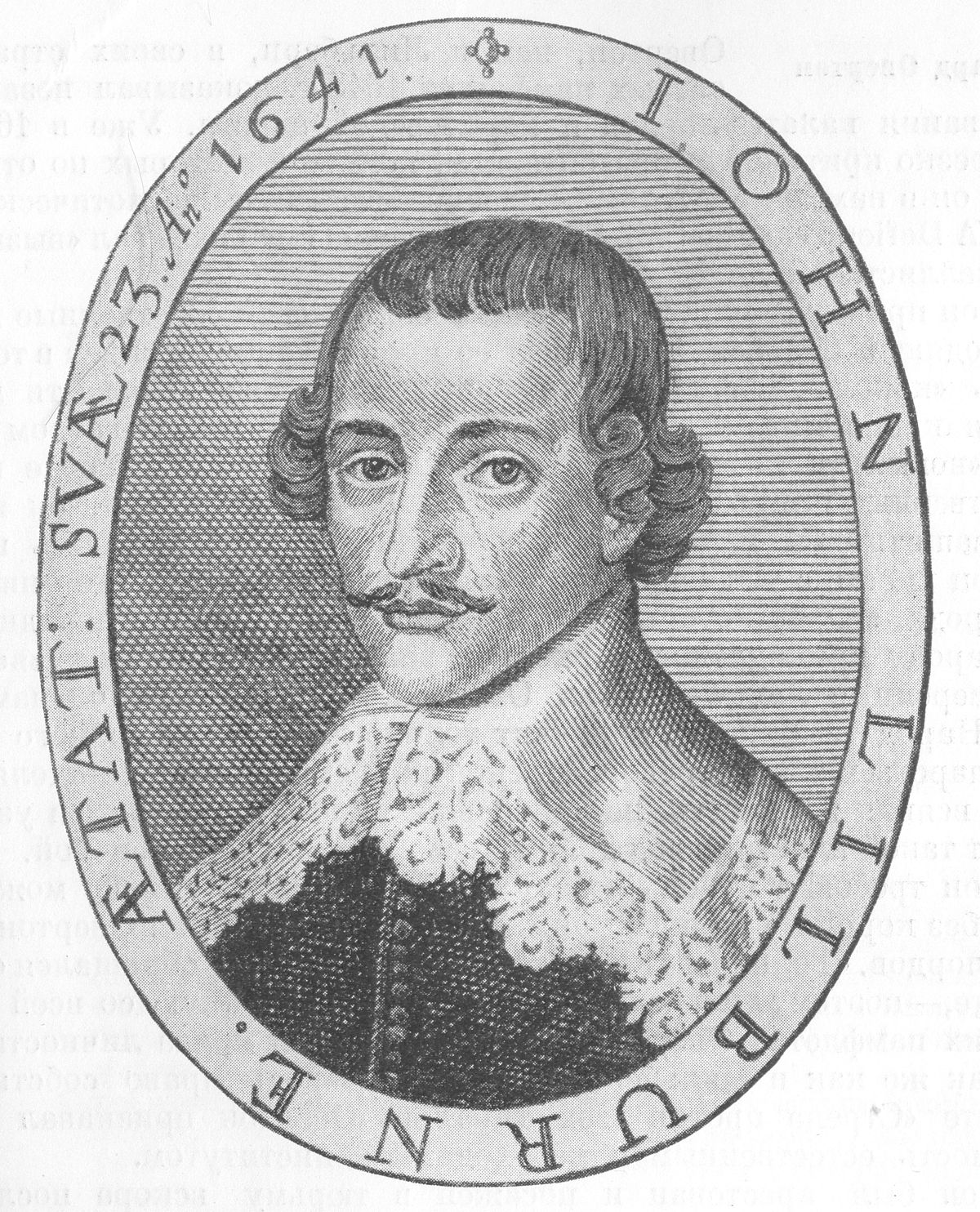
After the Royalist defeat at Naseby in 1645, Charles I escaped to Oxford, before surrendering to the Scots, who ransomed him to Parliament for £400,000, in January 1647. With the King a prisoner of Parliament, thoughts began to turn to how a lasting peace in England could be created. Would Charles return to the throne or would a more radical solution prevail? A radical plan was put forward by The Levellers, a political movement, who wanted to see greater equality. On Sunday 23rd, January 1648, Levellers ‘Freeborn John’ Lilburne and John Wildman brought their manifesto, ‘An Agreement of the People to Dartford. This argued the case for peace based on extended suffrage, equality before the law and religious tolerance.
Charles I a Prisoner of Parliament in 1647
By 1647, mutual suspicion had developed between Parliament and its own soldiers, The New Model Army, who wanted greater political and religious freedom. Charles was eager to exploit this and began secret negotiations with both sides and also the Scots whilst he was imprisoned at Hampton Court.
The Putney Debates
In August 1647, Cromwell and Henry Ireton put forward their ‘Heads of Proposals,’ which sought a peace that would retain Charles as King. Colonel Thomas Rainsborough responded with the Levellers’ plan, which would remove the King and give greater power to ordinary people. The Putney Debates, which took place from 28 October to 8 November 1647, were a series of discussions over the political settlement that should follow Parliament’s victory over Charles I in the First English Civil War. Both Ireton and Rainsborough’s plans were fiercely debated at St Mary’s church, Putney. However, as the debates ended, with no agreement reached, the urgency of developing a plan to bring about peace was emphasised by King Charles I’s escape from Hampton Court. The King’s escape seemed to confirm Rainsborough’s opinion that the King could never be trusted. It gave urgency to the Levellers’ demands that a new constitution should be drawn up that would take power away from the king, and give it to the people of England.
Cromwell and Ireton had tried to curb Leveller extremism at the Putney Debates, particularly over a proposal to extend the franchise to all adult males, which they saw as something that would destabilise the country in the aftermath of the Civil War.
‘Freeborn John’ Lilburne was not present at the Putney Debates. The Leveller position was instead argued by Colonel Thomas Rainsborough. He made a powerful speech advocating greater democracy. This Pitched him against the views of Cromwell and his brother-in-law Henry Ireton about who should be allowed to vote. They believed that only people with property should be able to decide the future of England through Parliament. Raisnborough argued passionately against Ireton. His words echo down to us through time:
The poorest he that is in England hath a life to live as the greatest he … I think it’s clear, that every man that is to live under a government ought first by his own consent to put himself under that government; and I do think that the poorest man in England is not at all bound in a strict sense to that government that he hath not had a voice to put himself under.
Meanwhile, Parliament denounced the Agreement as destructive to the government of the nation and ordered Fairfax to investigate its authorship. Attempts to gain wider Army support for the Agreement at the Corkbush Field rendezvous were forcibly suppressed by the Grandees. The leaders of the Parliamentarian cause were not prepared to share their newly won power with the people at large and were prepared to use lethal violence to ensure there was no extension of the franchise.
The Putney Debates proved to be one of the greatest intellectual encounters in Western political thought. They pioneered the liberal, democratic settlement we enjoy today: A Written constitution, universal suffrage, freedom of conscience & equality before the law.
An Agreement of the People
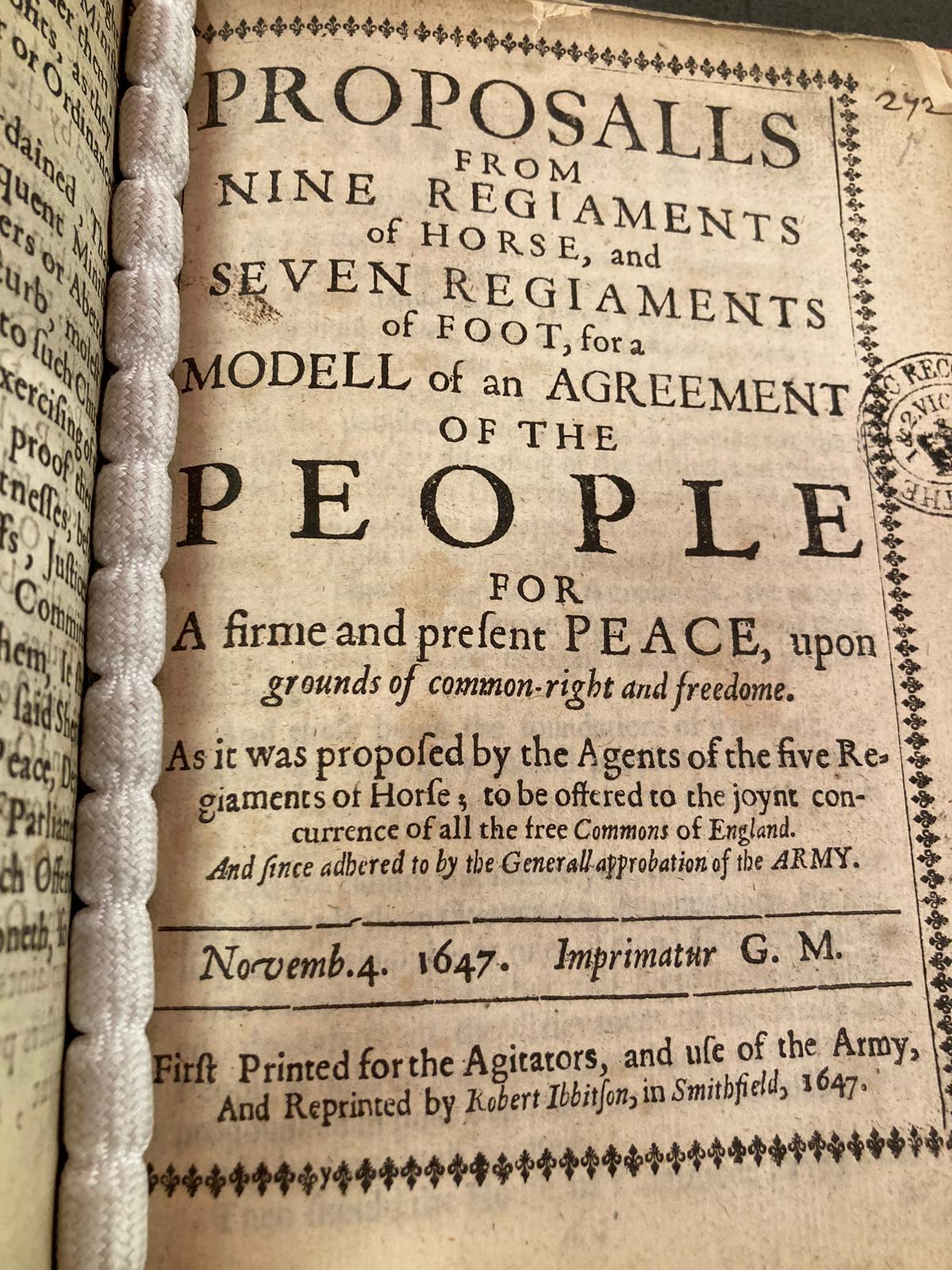
The Agreement of the People was the principal constitutional manifesto associated with the Levellers. It was intended to be a written constitution that would define the form and powers of government and would also set limits on those powers by reserving a set of inalienable rights to the people. It would take the form of a contract between the electorate and the representative, to be renewed at each election. The Agreement developed over several versions between October 1647 and May 1649.
Original Draft, 1647
An Agreement of the People for a firm and present peace upon grounds of common right was first drafted in October 1647 when Agitators of the New Model Army and civilian Levellers collaborated to propose an outline for a new constitution in the aftermath of the First Civil War. It was probably drafted by John Wildman though its authorship is not known for certain. Stating that sovereign power should reside in the people of England rather than with the discredited King or Parliament, the original Agreement consisted of four clauses:
- The peoples’ representatives (i.e. Members of Parliament) should be elected in proportion to the population of their constituencies
- The existing Parliament should be dissolved on 30 September 1648
- Future Parliaments should be elected biennially and sit every other year from April to September
- The biennial Parliament (consisting of a single elected House) should be the supreme authority in the land, with powers to make or repeal laws, appoint officials and conduct domestic and foreign policy
Certain constraints were placed on Parliament: it was not to interfere with freedom of religion; it was not to press men to serve in the armed forces; it could not prosecute anyone for their part in the recent war; it was not to exempt anyone from the ordinary course of the law; all laws passed by Parliament should be for the common good.
The Levellers come to Dartford: Sunday, Jan 23rd 1648
As 1648 began, Leveller leader, ‘Freeborn John’ Lilburne and his lawyer friend John
Wildman began seeking support for a peace based on greater democracy. On Sunday 23rd January 1648, they called the people of Kent to come to Dartford to sign their petition, ‘The Agreement of the People’ that would move England away from the absolute rule of monarchy and give power to the people by giving a vote to all men over 21. Lilburne and Wildman set up a base in Dartford from which they could begin a public appeal for support from the people of Kent. They called for those who wanted to see greater democracy to come to Dartford on Sunday 23rd January, 1648 to sign their petition calling for the implementation of An Agreement of the People. Their open letter to the people of Kent, drafted in Dartford on January 7th 1648, is reproduced below:
To all the peaceable and well-minded people in Kent, who desire present Peace, Freedom, Justice, and common Right, and good of all men, is, as followeth, the Original whereof is ready to be produced when occasion is. John Lilburn
Lilburn, John
John Wildman
Wildman, John
John Davies
Davies, John
Richard Woodward
Woodward, Richard 9. of Jan. 1648
Dartford Worthy Gentlemen, and dear Friends,
Our bowels are troubled, and our hearts pained within us, to behold the Divisions, Distractions, heart-burnings, and contentions which abound in this distressed Nation, and we are confounded in ourselves upon the foresight of the confusion and desolation, which will be the certain consequence of such divisions, if they should be but for a little time longer continued; there are now clouds of bloud over our heads again, and the very rumours and fears of Warre hath so wasted Trading, and enhanced the price of all food and clothing, that Famine is even entering into your gates; and doubtless, neither pen nor tongue can express the misery, which will ensue immediately upon the beginning of another Warre; Why therefore O our Countrymen, should we not every man say each to other, as Abraham to Lot, or Moses the two Israelites, Why should we contend each with other, seeing we are brethren? O that our advice might be acceptable to you, that you would every man expostulate each with other, and now while you have an opportunity, consider together, wherefore the contention hath been these six or seven years! Hath it not been for freedome and justice? O then propound each to other the chief principles of your freedome, and the foundation of justice, and common Right, and questionlesse, when you shall understand the desires each of other, you will unite together inviolably to pursue them.
Now truely in our apprehensions, this work is prepared to your hands in the Petition, which we herewith send to you; certainly, if you shall all joyne together to follow resolutely, and unweariedly, after the things contained in that Petition, the bloud and confusion which now threaten us may be prevented, and the sweet streames of justice will run into your besomes freely without obstruction; O that the Lord may be so propitious to this tottering Nation, as to give you to understand these things which belong to your Peace and welfare!
Many honest people are resolved already to unite together in that Petition, & to prosecute the obtaining it with all their strength; they are determined, that now after seven years waiting for Justice, Peace, and Freedome, they will receive no deniall in these requests which are so essentiall to their Peace and Freedome; and for the more effectuall proceedings in this businesse, there is a Method and Order setled in all the Wards in London, and the out Parishes and Suburbs; they have appointed severall active men in every Ward and Division, to be a Committee, to take the speciall care of the businesse, and to appoint active men in every Parish, to read the Petition at set meetings for that purpose, and to take Subscriptions, and to move as many as can possibly, to goe in person when the day of delivering it shall be appointed; and they intend to give notice of that time to all the adjacent Counties, that as many of them as possibly can, may also joyne with them the same day; and the like orderly way of proceeding is commended to severall Counties, to whom the Petition is sent, as to Hartfordshier, Buckingham, Oxford, Cambridge, Rutlandshier, &c. And we cannot but propound to you the same Method, as the best expedient for your union, in pursuing after a speedy settlement of your Peace and Freedome, therefore in brief we desire,
1. That you would appoint meetings in every Division of your County, and there to select faithful men of public spirits, to take care that the Petition be sent to the hands of the most active men in every Town, to unite the Town in those desires of common right, and to take their subscriptions.
2. That you would appoint as many as can with convenience, to meet at Dartford, the 23. of this present January, being Lords day, and we shall conferre with you about the Matters that concerne your Peace, and common good and Freedome.
We shall at present adde no more but this, that to serve you, and our whole country in whatsoever concerns its common peace and wellfare, is, and always shall be, the desire and joy of
Your most Faithfull Friends and Servants which came from London from many other friends upon this Service, Dartford
this
9. of Jan. 1647.
John Lilburn.
John Wildman.
John Davies.
Richard Woodward.
Well minded People,
The Whitehall Debates, 1648-1649
Following their visit to Dartford in January 1648, Lilburne and Wildman were arrested on new charges of sedition after denouncing the House of Lords during a volatile meeting of Levellers at Smithfield. they were later called before the House of Commons to defend themselves against the accusation of sedition. Their answers to questions put to them by M.P.s were recorded and are reproduced here in the Journal of the House of Commons for 1648.
During the Second Civil War, the Presbyterian John Maynard MP secured Lilburne’s unconditional release from the Tower in the vain hope of gaining his support in a scheme to impeach Oliver Cromwell. Lilburne refused to join the attack at a time when Cromwell was away fighting the Royalists and their Scottish allies. Nevertheless, he distrusted the Grandees and feared that the army was becoming an even greater tyranny than the monarchy. He negotiated with Henry Ireton at meetings between the Grandees and the Levellers at Whitehall in December 1648. Lilburne urged the Grandees to accept the Agreement of the People before bringing the King to trial so that at least the trial would have a basis in a legitimate constitution, but he was completely outmanoeuvred by Ireton and the Leveller’s demands came to nothing. Lilburne refused a nomination to sit on the High Court of Justice and left London for the north during the period of the King’s trial and execution.
Lilburne and Wildman continued to debate with their Leveller supporters and refine their proposals. The Armies Petition, or a new Engagement was drafted by a group of Agitators at St Albans in April 1648 and was published in tandem with a related civilian broadside, A New Engagement, or Manifesto. These documents expanded upon the original Agreement to include more specific proposals for legal and economic reform.
After the King’s defeat in the Second Civil War, John Lilburne promoted an extended version of the Agreement which was discussed by a committee of Levellers, London Independents, MPs and army Grandees at Whitehall in December 1648. These discussions took place in the aftermath of Pride’s Purge when the King’s trial was imminent.
Lilburne wanted to secure Parliament’s acceptance of the Agreement before the King was brought to trial so that the trial would have a basis in a legitimate and legal constitution. However, Lilburne and his colleague Richard Overton walked out of the discussions when Army officers led by Henry Ireton insisted upon making further modifications to the Agreement before it was presented to Parliament.
The discussions continued in Lilburne’s absence. While Ireton appeared to make concessions to the Levellers over the franchise, it is probable that he was playing for time to distract the Army Levellers while preparations for the King’s trial went ahead. The revised Agreement was finally presented to the House of Commons as a proposal for a new constitution on 20 January 1649, the very day that the public sessions of the High Court of Justice began. As Ireton had calculated, MPs postponed discussion of the Agreement until after the trial, and it was never taken up again by Parliament.
Final version, May 1649
The Grandees’ modification of the Agreement of January 1649 was the Army’s last official involvement in its evolution. However, Lilburne and the civilian Levellers regarded Ireton’s intervention as a betrayal and continued to refine their proposals. A fully developed version of the Agreement — An Agreement of the Free People of England, tendered as a Peace-Offering to this distressed Nation — was published in May 1649, signed jointly by John Lilburne, Richard Overton, William Walwyn and Thomas Prince. Its proposals included:
- The right to vote for all men over the age of 21 (except servants, beggars and Royalists)
- Annual elections to Parliament with MPs serving one term only
- No army officer, treasurer or lawyer could be an MP (to prevent conflict of interest)
- Equality of all persons before the law
- Trials should be heard before 12 jurymen, freely chosen by their community
- The law should proceed in English and cases should not extend longer than six months
- No one could be punished for refusing to testify against themselves in criminal cases
- The death penalty is to be applied only in cases of murder
- Abolition of imprisonment for debt
- Tithes should be abolished and parishioners have the right to choose their ministers
- Taxation in proportion to real or personal property
- Abolition of military conscription, monopolies and excise taxes
The final version was published after the Leveller leaders had been imprisoned by order of the Council of State and a few weeks before the suppression of the Army Levellers at Burford, after which the Leveller movement was effectively finished.



No Comments
Add a comment about this page