


When researching the background to our Vindication of Christmas project, CRAY’s team of researchers discovered the story behind the performance of Ben Johnson’s, ‘The Masque of Blackness.’ This took place at the Banqueting House, Whitehall, on 12th Night (6th January) 1605. We wanted to find out why the Puritans became so angry with the celebration of Christmas and how this led to its banning during the English Civil War. The story we uncovered was a deeply offensive one. However, it helped us to understand the mentality of a period in history, that would ultimately lead to the cancellation of Christmas and a deadly conflict.
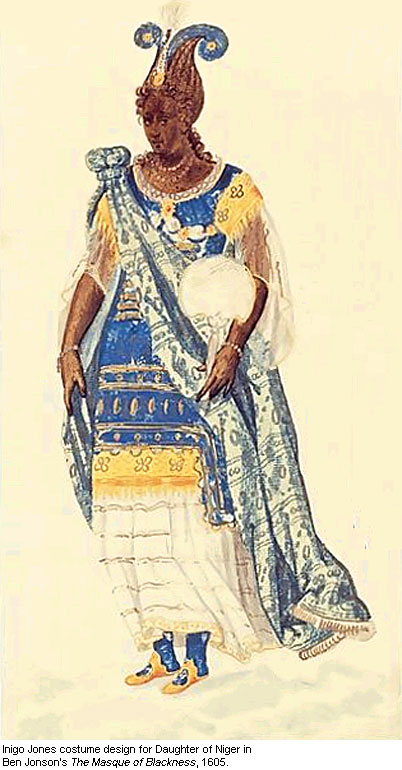
Once we began undertaking research for the development of this website, CRAY found as many images and sources as we could find that could help us to understand the key themes of our story. As many CRAY members are of African descent, Heritage Fund was keen to see us look at aspects of Black history in this period. We soon came across, ‘The Masque of Blackness,’ and thought that the Puritan anger at this Ben Johnson/Inigo Jones production would help to explain how Christmas came to be banned. A number of Inigo Jones costume illustrations for Queen Anne of Denmark and her ladies-in-waiting were available online. We were able to gather these together for our artist Kate Morton so that she could recreate how this controversial masque would have looked. Kate’s picture shows the opening of the masque, when the twelve water nymphs played by Queen Anne and her ladies-in-waiting appear on stage in colourful blue and silver dresses When Kate finished her picture, she came to Crayford Library to meet our young CRAY volunteers. She asked Rakhmat Mustapha and Rachel Poku to caption her picture for this article. They researched the background to the opening scene which controversially shows the twelve nymphs adopting blackface make-up. This is what they initially had to say:
The picture illustrates the play of the Masque of Blackness. It was first performed at the Stuart Court in the Banqueting Hall of Whitehall Palace on the Twelfth Night, 6th January 1605. The play was written by Ben Jonson and the costumes, sets, and stage effects were designed by Inigo Jones. The performance required the masquers to be disguised as Africans. Anne of Denmark, the Queen consort of King James I, performed alongside her court ladies all of whom had blackface makeup. Anne dressed up as Euphoris and the other ladies dressed up as characters such as Aglaia, Diaphane and many more. The concept of the Masque of Blackness was a bit controversial at the time it was written and produced. The play condemns Africans as unattractive and naturally inferior to the ‘great’ white man of England.
What is a Masque?
The term masque refers to a specific type of play that requires a lot of production, both before and during the show. As masques combined song, dance, poetry, and elaborate stages and costumes the producers of the show needed a lot of expensive planning and preparation. Only the King and his richest courtiers could afford to stage such shows. The extravagant expenditure needed for a masque was contrary to the frugal instincts of most Puritans and hence a major reason for the anger that these performances generated amongst the ‘Godly.’
The majority of masques performed at the Banqueting Hall stressed the greatness of the King. This was for the obvious reason that if the writer wanted to continue to stage shows he needed to flatter the King to open his purse strings. Ben Johnson wrote many masques and most of them made use of metaphors and comparisons between the King and classical or literary figures that would flatter him (like the Roman gods or the Arthurian legends).
The Plot
Ben Jonson was eager to gain the patronage of the King, so his work praised the monarchy through song, poetry, and elaborate spectacle. In The Masque of Blackness, King James I is compared to the sun, shining brightly enough to bleach the skin of African goddesses who are dismayed by their skin colour. Queen Anne wanted to use the novelty of performing as an African to highlight that the power of the Stuart dynasty stretched far beyond these shores.
Johnson’s masque begins with the Queen and her ladies-in-waiting arriving on stage dressed as the twelve nymphs and borne in a giant seashell. They are accompanied by two male actors, Oceanus (the god of the Atlantic Ocean) and Niger (who is the god of the Niger River in Africa and also Oceanus’ son). The nymphs are dressed in silver clothes to offset the dark makeup on their bodies. The idea of using makeup instead of masks, (which is how these shows got their name) was very unusual for a play of this period.
The nymphs are informed by the poets of the North that they are not as beautiful as they once thought they were. They now curse the African sun in Ethiopia that gave them life for making them too dark. The moon goddess, Aethipoia, appears to the nymphs to help them solve their dilemma, by informing them they need to find a land which ended in -tania and there they would find their answer. There, the sun shines brightly all day long, and in its light, their skin will turn pale. Having tried their luck with no success in Mauritania, Lusitania (another name for Portugal), and Aquitania (another name for France), they are about to give up.
At this point, the moon goddess enters again and solves her own riddle. The country they are looking for is Britannia, the best place in the world that is “ruled by a sun” (King James I) whose light is like magic and medicine all in one. The nymphs celebrate with a dance.
Typically, masques would end with the unmasking of the performers, revealing who in the court had acted in which role. But because this masque used makeup rather than masks, this did not happen. Instead, Johnson set up a potential sequel, The Masque of Beauty, which was performed a few years later. This sequel followed up the final announcement by the Moon Goddess in The Masque of Blackness who announces that if the twelve goddesses swim in the king’s light once a month for a year, then they would enhance their beauty through their newly white skin.
17th Century Controversy
The play was very controversial in 1605. Queen Anne wanted the play to question the gender norms of the time, particularly the Puritan belief that women should not perform on stage. Both Queen Anne and later King Charles I’s wife Henrietta -Maria would be criticised for their willingness to perform on stage. William Prynne’s, Histrio Mastrix (1633) would condemn female actors as ‘whores.’ Prynne would famously lose his ears for the remark and the implied criticism of the King’s wife. However, for many Puritans, The Masque of Blackness disgraced the Stuart royal family further by allowing the Queen to appear in blackface. Whereas today the black makeup in itself would be seen as offensive to African people, for the Puritans of the 17th century it was controversial because Queen Anne was damaging her own image by making herself ‘foreign’ or ‘uncivilised’ and to the Puritans ‘impure.’ Puritans admired thrift, but the staging of The Masque of Blackness was hugely expensive, and to the King’s critics wasteful and hence ‘ungodly.’
What can we learn from The Masque of Blackness about 17th-century England?
The Masque of Blackness hints at Jacobean England’s attitudes towards race. It was written at the very beginnings of the British Empire when the Stuart monarchy was trying to portray its power over foreign and exotic fields. The masque appears to insinuate that black is inferior and that the divine power of King James can solve this ‘problem.’
The masque was also criticised heavily for the prominent role women took in its staging. Puritans objected to women performing and thought it degrading to see the Queen performing on stage. They also objected to celebrations at Christmas, which they saw as a Pagan festival. The Masque of Blackness seemed to fit with their belief that the country was being corrupted by ‘foreign ways.’ This 1605 performance would be followed by many more masques in the reign of King Charles I at the Banqueting Hall. These Christmas extravaganzas would continue to be a focal point for increasing Puritan anger. King Charles I’s wife, Queen Henrietta-Maria, took a leading role in these masques. As a French, Catholic, she embodied the ‘foreign threat’ to England that was exemplified by these Christmas 12th Night performances.




No Comments
Add a comment about this page