


Dr Thomas Vane’s arrival as Crayford rector inflamed the local culture wars between the Anglican traditionalists he favoured and the strict Bible-based views espoused by Puritans. The Dartford area was a hotbed for Puritan belief. It had seen the burning of three Protestant martyrs in the reign of ‘Bloody Mary’ in 1555 and was to host the radical preacher Vavasor Powell at Holy Trinity Church, Dartford during the Civil War.
Root and Branch Reform of the Church of England
The period between the arrival of rector Dr Thomas Vane in Crayford in 1627 and the outbreak of civil war in 1642, was full of religious unrest. As a high church “Arminian“, Vane found himself in direct confrontation with local radical Puritans. In 1640, Charles I was forced to call his first parliament for 11 years. Known as ‘The Long Parliament ‘ it opened in November and by December 1640 Puritan MPs sought to
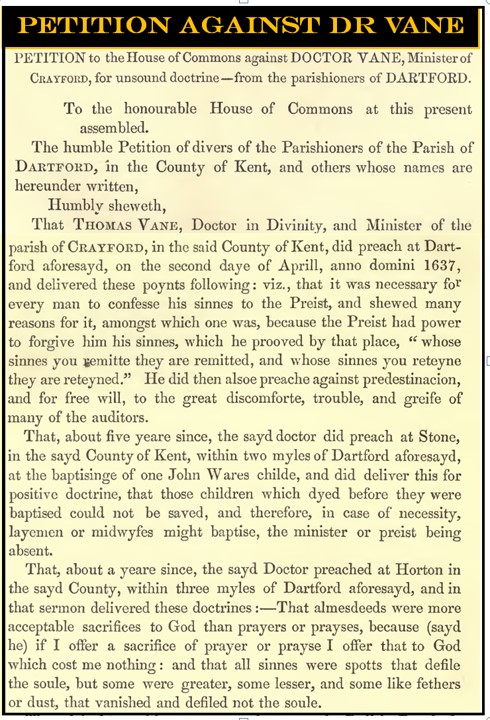
push through reform of the Anglican church with the “Root and Branch” Petition. This called for the abolition of bishops from the Church of England and its reform “root and branch” was presented to Parliament. A number of grievances had built up during the long eleven years without a parliament to try and address them. Among these grievances were Puritan attempts to remove all traces of ‘Popery’, Catholic traces from the established church. It was against this backdrop that a group of Dartford Puritans petitioned parliament to have Dr Thomas Vane removed as Crayford’s rector. Their petition was addressed to Sir Edward Dering, a Kentish M.P. who had been appointed as Chairman of the Sub-Committee of Religion on November 23, 1640.
The Puritan Fanatics of Horton Kirby: A Witch Trial
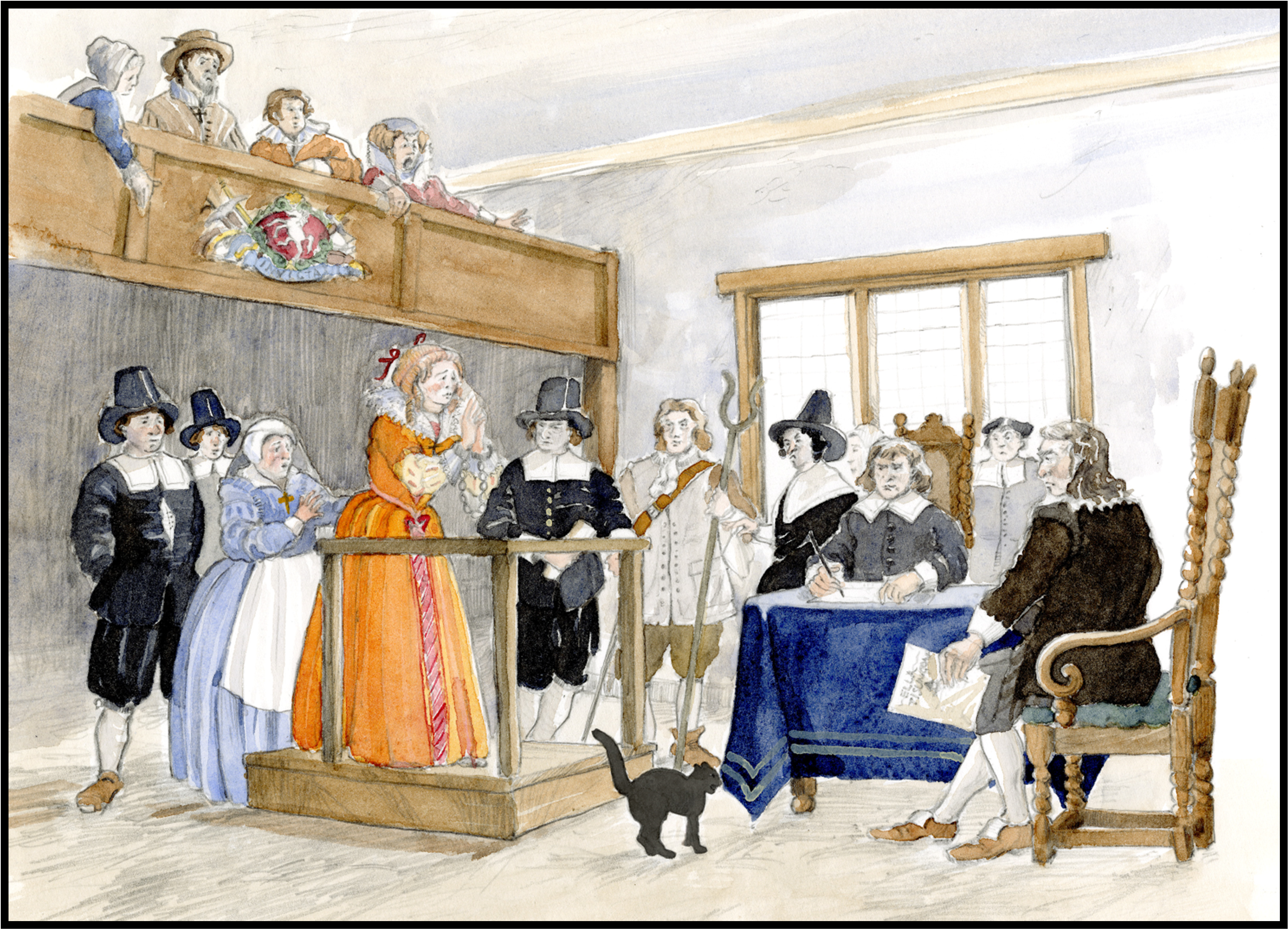
Looking at the petition you will notice reference to complaints from the parish of Horton Kirby, just outside Dartford. They were amongst the most fanatical of local Puritans. In 1635, five years before the petition, the people of Horton Kirby accused one of their fellow parishioners of witchcraft. A brief examination of this case can highlight the extremist ways of Puritans at this time.
Horton Kirby farmer’s wife, Ellen Tislington accused of witchcraft
Ellen Tislington was the wife of a yeoman farmer from Horton Kirby. In 1635 her parish rector, the Puritan firebrand Frances Cornewall and his wife Anne were among a band of parishioners who were convinced that Ellen had used witchcraft to target one of their elect ‘Godly’ band. According to the Maidstone Quarter Sessions indictment, Ellen had, “bewitched Andrew Lewis so that he languished and his body was wasted.“
When Ellen Tislington was accused of witchcraft an Indictment was drawn up for her trial at Maidstone where the West Kent Assizes took place. Those like the Cornewalls named on the indictment were the witnesses who would be called to give evidence against her. Before her trial, Ellen would have faced some form of an examination to look for signs of the devil. That she was found NOT GUILTY probably means that whoever undertook the examination failed to draw a confession from her.
INDICTMENT of Ellen Tislington
Wife of George Tislington of Horton Kirby, husbandman, for witchcraft. On 1 July 1635, at Horton Kirby, being a common witch, she bewitched Andrew Lewis so that he languished and his body was wasted.
Endorsed Francis Cornewall, Anne Cornewall, Thomas Lewis, Rachel Lewis, Rachel Browne, George Weller, Denise Clerke, Margaret Johnson, Elisabeth Staple.
True Bill (Enough evidence to go to court) NOT GUILTY
Interestingly, the indictment is marked as a true bill. This indicates that the court at Maidstone believed there was sufficient evidence of witchcraft for this case to go to trial.
Those found guilty would be executed. However, the jury at Maidstone decided that Ellen Tislington was NOT GUILTY. She was fortunate that in England trial by jury could still prevail against injustice. The good men and women of Maidstone obviously did not believe the Cornewall’s accusations of witchcraft. Even in this period, people were suspicious of attempts of men like Andrew Lewis pretending to be bewitched to incriminate an enemy. Juries, at least in Kent, were aware that not all cases of witchcraft were genuine. In Essex, the women swept up by the mania created by the Witchfinder General Mathew Hopkins in the 1640s were not so lucky.
Witchcraft an Obsession of radical Puritans
Many radical Puritans saw the Pope as the Anti-Christ and the Catholic Mass as a form of sorcery. Anyone suspected of favouring Catholic traditions like Dr Thomas Vane could thus be seen as literally ‘diabolical.’ Their influence would have been seen by Puritans as a malignant force in the parish where they worked and like a cancer they had to be removed. This was the way Frances Cornewall, the rector of Horton Kirby, thought. His Puritan beliefs would later lead him to become an influential figure in the founding of the Baptist church. He had a genuine fear of witchcraft and equated the ‘Papist’ thinking of men like Vane as the work of the Devil. He felt that his parish needed to be cleansed from this danger.
The fear of witches, witchcraft, and bewitchment was perceived by men like Cornewall and his wife Anne to be a threat to their church and the order of the parish. Ellen Tislington’s trial in 1635 occurred at a time of increasing uncertainty in the build-up to the English Civil War. There were often more witchcraft accusations during times of war and famine. General fears of witchcraft within society could also feed into specific accusations that originated within a small village like Horton Kirby. It was likely that Ellen Tislington was disliked by her fellow Horton Kirbians. She may have even shared the traditional ‘Catholic’ beliefs of Dr Thomas Vane. In this case, to have views that differed from the parish rector could be dangerous. This would have made her vulnerable to being accused of witchcraft. Once rector Cornewall took against her then her neighbours were sure to follow and take it upon themselves to try to punish her.
The other factor that Ellen Tislington faced at her trial that worked against her was that she was a woman. Witchcraft was particularly associated with women in the early modern period. Even today our image of witchcraft at Halloween is of a woman riding on a broomstick with a pointy hat. Women were more likely to be accused because of the church’s teaching that women were the weaker sex, seen as more vulnerable to the seductive powers of the Devil. Therefore, accusations of witchcraft became another way for women to be oppressed in early modern society.
We don’t know whether Ellen Tislington was new to the parish of Horton Kirby and might have been accused of witchcraft because her neighbours were suspicious of her and her husband. Sometimes someone like Andrew Lewis might pretend to be bewitched because it was he could make money. His description makes it obvious that he had a debilitating illness so this could have been an attempt to raise funds to support him through his illness. People were more suspicious of witchcraft when the harvest failed, as they looked to find a cause. Ellen was a yeoman farmer’s wife so this could have been a factor in 1635 when harvest yields were below average.
Horton Kirby Emigrants to Salem Massachusetts
Witchcraft trials like the Tislington case were ways for grievances and disputes to be aired, and for people to stand in testimony for or against their neighbours. there was often a group hysteria involved that quickly led to villagers ganging up on individuals in their parish who were considered as outsiders for one reason or another. This is indicative of the infamous Salem Witch trials sixty years after events in Horton Kirby. The Salem witch trials were a series of hearings and prosecutions of people accused of witchcraft in colonial Massachusetts between February 1692 and May 1693. More than 200 people were accused. Thirty people were found guilty, 19 of whom were executed by hanging. Whilst researching the Ellen Tislington trial, CRAY discovered a link between Horton Kirby and Salem. The Scudders a prominent family of English Puritans left Horton Kirby for Salm in 1637, two years after the Tislington trial. The 1630s was a period of large-scale emigration to North America by English Puritans who rebelled against the apparent rejection of their Sabbatarian beliefs by Charles I’s re-issue of the Book of Sports in 1633. It’s quite possible that this was a key factor in the Scudders departing for a land where they could follow their strict religious beliefs unimpeded by such laws. In effect, England exported the most extreme of its Puritans to the North American colonies during this period. Their extreme beliefs prepared the ground for the infamous Salem trials. The fascinating story of the Scudders can be found on this link: https://scudder.org/thomas-scudder-t-line/
Dartford’s Protestant Martyrs 1555
In many ways, therefore, understanding what happened in Horton Kirby tells us less about the supernatural than it does about the realities of everyday life for ordinary people. Many people in England at this time were extremely anti-Catholic due to numerous events in the previous decades whereby English Protestantism had appeared to have been under grave threat from abroad. Events such as the defeat of the Spanish Armada in 1588 and the Gunpowder Plot in 1605 had put the country on edge. In our area, the ‘anti-Papist’ feeling had been stoked by the deaths of Dartford’s Protestant Martyrs during the reign of the Catholic Queen ‘Bloody’ Mary. During her reign, from 1553-1558, three hundred Protestants were burnt at the stake for their beliefs, three of them were from Dartford – Christopher Waid, Nicholas Hall and Margery Polley. A memorial to them stands in the cemetery at East Hill, Dartford. They became known as the Dartford Protestant Martyrs and were burnt at the stake for their beliefs in 1555.
Kent Today: The Dartford Protestant Martyrs
On this Day in Tudor History: The Dartford Protestant Martyrs 1555 by Claire Ridgway
The terrible fate of Dartford’s Protestant Martyrs lived long enough in the folk memory of the town for the Victorians to build a memorial to Waid, Hall and Polley. If the memory was still alive three hundred years later in the reign of Queen Victoria, it is not surprising that feelings remained raw in the 1630s under the reign of Charles I. It ensured that Dartford was a centre of anti-Catholic feelings in the build-up to the English Civil War. Dr Thomas Vane acted as a lightning rod for this Protestant anger
It didn’t help that the rector of Horton Kirby was a Puritan. Many Puritans despised Catholicism due to their contradictory beliefs. Despite both being denominations of Christianity, Catholicism revolved heavily on idolatry with the use of crucifixes, the Virgin Mary and stained glass windows which Puritans found sinful as this form of worship was against teachings in the bible. Frances Cornewall, said rector of Horton Kirby, was one of those who endorsed the trail. If found guilty, Tislington would have been burnt at the stake. This is just one of the many extremist ways that Puritans would retaliate against those who did not share their religious beliefs.



No Comments
Add a comment about this page