
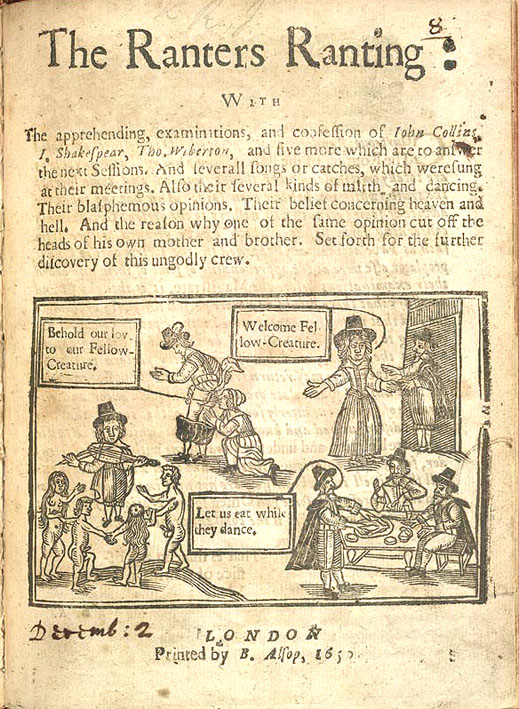
![The ranters ranting: with the apprehending, examinations, and confession of Iohn Collins [and others] | The British Library](https://www.crayfordhistory.org.uk/wp-content/uploads/2023/10/Rantersranting-l-482x658.jpg "The British Library")


Dartford, during the Civil War, proved itself to be a hotbed of idealists. Radicals, Vavasor Powell and Leveller John Lilburne had all found an audience in the town.
After the failed Royalist uprising of 1648, the New Model Army garrisoned Colonel Nathaniel Rich’s regiment of horses in the town. Many of Rich’s men gathered in the market square to listen to the famous preacher Laurence Clarkson, who was part of a radical group of Protestants known as the Ranters.
Who were the Ranters?
The Ranters were one of a number of dissenting groups that emerged in the aftermath of the Second Civil War (1648–1660). They were largely common people, and the movement was widespread throughout England, though they were not organised and had no leader. The Ranters denied the authority of churches, of scripture, of the current ministry and of services, instead calling on men to listen to the divine within them. Their central idea was pantheistic, that God is essentially in every creature, including themselves.
If God be in all things, then in all creatures that hath live whatsoever, so that wherein is man better than these, or hath any pre-eminence above these?
— Laurence Clarkson, A Single Eye (1650).
The Ranters were symbolic of the outbreak of religious eccentricity in the 17th century. Clarkson himself led a life that was often chaotic and bordered on the edge of lunacy. According to Christopher Hill in his book The World Turned Upside-Down: Radical Ideas During the English Revolution:
From, say, 1645 to 1653, there was a great overturning, questioning, and revaluing, of everything in England. Old institutions, old beliefs, and old values came into question. Men moved easily from one critical group to another, and a Quaker of the early 1650s had far more in common with a Leveller, a Digger or a Ranter than with a modern member of the Society of Friends.
Levellers? Diggers? Ranters? Crayford and Dartford saw advocates of them all as they passed along the Dover Road to London. There were also Fifth Monarchists, Seekers, Mechanic Preachers, Grindletonians, Millenarians, Familists, and Brownists, which were other examples of sectaries that flourished at this time. Dartford’s larger-than-life rector Vavasor Powell would adopt the ideas of the Fifth Monarchists when he left Dartford. Members of this sect believed the execution of Charles I in January 1649 marked the end of the Fourth Monarchy and viewed both the institution of the Protectorate in 1653 and the 1660 Stuart Restoration as preventing the coming of the Fifth and the second coming of Christ. Many groups like the Fifth Monarchists cherry-picked the Bible to support their beliefs, whilst others like the Ranters often decided that the Bible was of no relevance at all.
Who was Laurence Clarkson?
Laurence Clarkson (1615–1667), sometimes called Claxton, was born in Preston Lancashire. He was the most outspoken and notorious of the loose collection of radical Protestants that became known as the Ranters.
Clarkson’s ideas are set out in a 1650 tract sponsored by the wealthy Leveller military man, William Rainborowe, called A Single Eye. Clarkson opposed the idea of sin and felt that only the intention of an act, and nothing at all about its content, mattered to God. In this sense, the only commandment he felt worthwhile was “Thou shalt not kill.” Clarkson considered the danger of sin to be in the mind:
“Till acted that so-called Sin, thou art not delivered from the power of sin, but ready upon all Alarums to tremble and fear the reproach of thy body.”
Why were the Ranters referred to as Antinomians?
Laurence Clarkson’s ranter beliefs are often referred to as being Antinomian. This term comes from the Greek meaning lawless. Many Christians consider it a pejorative term as it puts forward a belief that Christians are under no obligation to obey laws of ethics or morality. Clarkson would never have considered himself an “antinomian,”, as this was the charge that was normally levelled against him by those who opposed his ideas of intellectual and sexual freedom. Antinomianism may be viewed as the polar opposite of legalism, the notion that obedience to a code of religious laws such as those laid out in the Ten Commandments would be necessary for salvation.
How did Clarkson come to preach in Dartford?
After the defeat to the Royalists at the Battle of Maidstone, on 1st June 1648, General Fairfax pursued the remaining Royalist forces to Colchester in Essex. Before leaving Kent, Fairfax delegated command of the Parliamentarian forces in the county to Colonel Nathaniel Rich. He was ordered to deal with the remnants of the Kentish revolt in the east of the county, where the naval vessels in the Downs had gone over to the Royalists and Royalist forces had taken control of the three previously Parliamentarian “castles of the Downs” (Walmer, Deal, and Sandown) and were trying to take control of Dover Castle. After Cromwell’s victory at Preston, on 23rd August 1648, most Royalist hope was lost and two days later Deal’s garrison surrendered, followed by Sandown on 5 September. This finally ended the Kentish rebellion. Rich then deployed his soldiers to strategic areas of Kent to ensure that there were no further outbreaks of rebellion. Crayford rector Thomas Thorowgood’s diary records this moment, as he recounted how some of Rich’s men were garrisoned upon him at the rectory in Crayford:
The Parlamt Army lay sore upon me, 20 or 30 at a time & in conclusion calling me Cavallier Rogue they tooke away my Horse and whatever else they found. ’
Thomas Thorowgood’s Diary 1648 CongregatIonal Church HIstorIcal Society (1925)
Other members of Colonel Rich’s New Model Horse were garrisoned in Dartford and Gravesend. Laurence Clarkson recounts in his book, ‘The Lost Sheep,’ that he came across them in Gravesend when he had crossed the Thames seeking to preach in Kent. He was invited to come to Dartford to preach by one of Rich’s junior officers, Cornet Nicholas Lockyer.
Following their victory in the Second Civil War, Lockyer’s men wanted to see radical change to reward them for the blood that had been spilt to defeat the King. They were open to new ideas, to radical ideas, and nobody had more radical ideas than Laurence Clarkson. He spoke to Lockyer’s men, who were billeted in and around Crayford and Dartford, in the town’s Market Square.
Clarkson’s account does not reveal what he preached in Dartford. However, we can guess from his written ideas from that period what he may have said to Lockyer’s men. His beliefs at this time included, as stated previously, that the idea of sin had been, “invented by the ruling class to keep the poor in order,” and that the only commandment he felt worthwhile was “Thou shalt not kill.” Clarkson admitted that most of the others he had broken often, particularly the commandment forbidding adultery. He saw nothing wrong with this, and this later gained him a reputation for sexual promiscuity.
Clarkson also supported the ‘proto-communist’ ideas of Gerrard Winstanley and his Diggers, or True Levellers, who set up a commune on common ground at St George’s Hills, Surrey in 1649.
Clarkson’s ranter beliefs, and in particular advocacy of free love and communal living, are reminiscent of the 1960s ‘Hippy movement.’ His brief visit to Dartford highlights how far the rigid rules of pre-Civil War society had been undermined.




No Comments
Add a comment about this page