


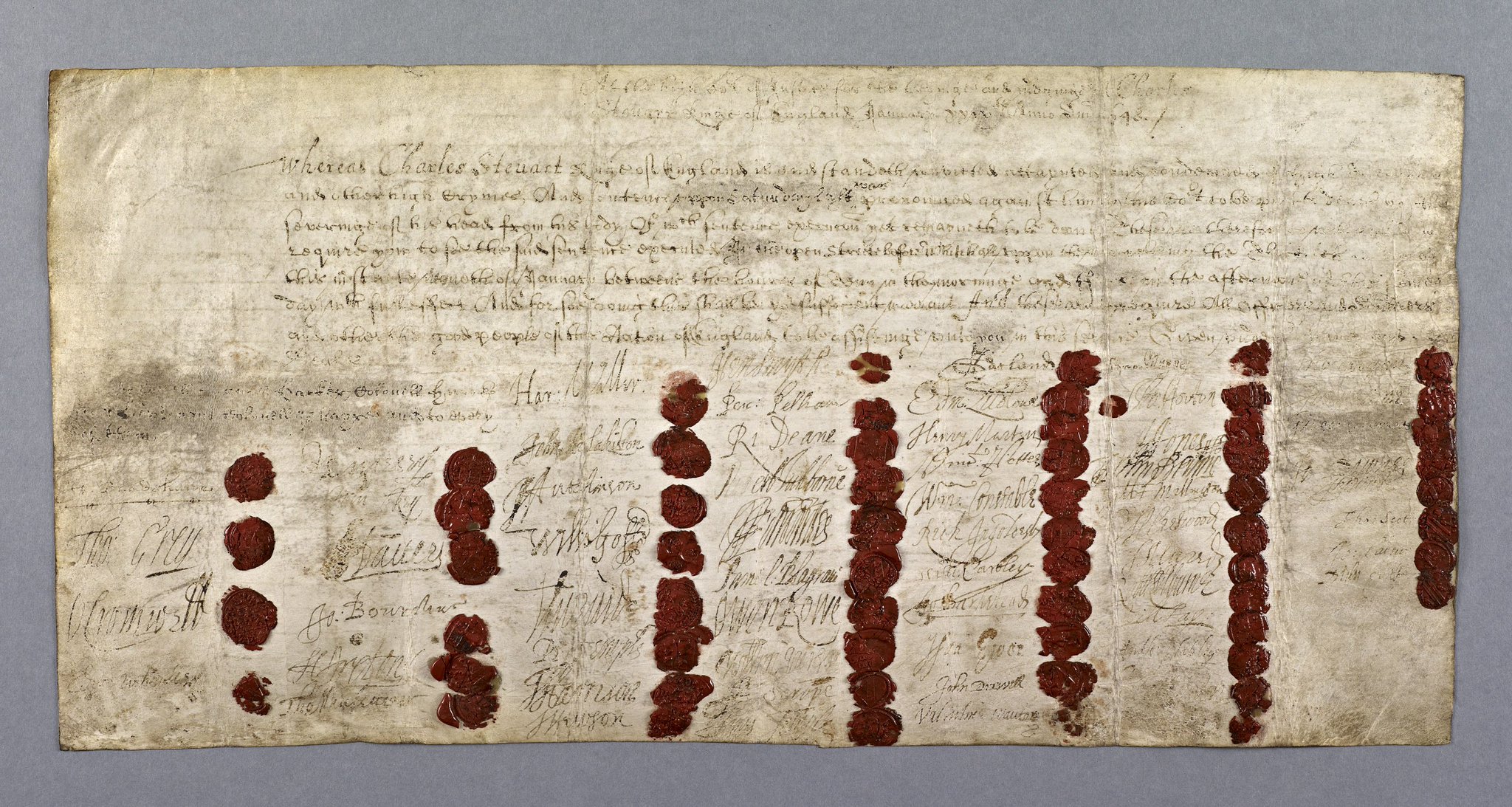
Crayford’s rector from 1647-1649 was the Parliament-imposed Puritan, Thomas Thorowgood. He arrived in Crayford from his native Norfolk because it suited him to be closer to London as a leading member of the Westminster Assembly of Divines. These were the men who had influenced the ordinance banning Christmas in 1644. Thorowgood’s time as Crayford’s rector coincided with the trial and execution of Charles I. His diary, transcribed by the Congregational Church Historical Society in 1925, shows that Crayford’s rector was at the centre of national events. It highlights the pressure put on him by Cromwell to become a regicide.
Evidence of the enduring unpopularity of Thomas Throwgood in Crayford remains in his continued absence from the St Paulinus Church rector board. He was a Puritan imposed by parliament on a parish that had for many years been overseen by the distinctly Catholic and Royalist figures of Dr Thomas Vane and his curate, the poet Edward May. His diary entries for 1647 highlight that he arrived in Crayford shortly after Vane had been forced to flee because of his links to Queen Henrietta Maria who had persuaded him to renounce his Anglican faith in favour of conversion to Catholicism. Curate Edward May, had stepped into Vane’s shoes and showed this through his support of the Royalist rebellion in 1648.
About this time for several reasons I quitted my employment in Norfolk was invited into Kent & finding the place legally voide I accepted of it & there remained till ye ruining Engagement cashiered me. Ye Troubles were by then most in that County.
An ambiguous line in Throwgood’s diary mentions two men who had brought about his difficult time in Crayford. Could these possibly be Vane and May?
My great losses in Kent are certified by 2 men of Crayford who I have but never had any recompense
After the Royalist defeat at Maidstone on June 1st 1648, we know that many Crayford men were fined for their part in the rebellion. One of these men was Edward May who was not allowed to come within twelve miles of Crayford. It was probably this event that led to local anger being directed at Thorowgood. These lines in his diary seem to indicate he had been accused of betraying local Crayford men, possibly including Edward May, to Kent’s Parliamentary Committee. This was an accusation that Thorowgood strongly denied in his diary. It was also the accusations that years later would lead to Throwgood’s name being excluded from the St Paulinus rector board:
No man can say I was at any time instrumental to the molestation or sequestering of anyone, neither did I ever directly or indirectly go about to invade or possess the Title or Interest of any.
Thorowgood found himself with enemies on both sides of the Cavalier/Roundhead divide. Whilst Crayfordians saw him as a parliament stooge, the New Model Army men garrisoned in Crayford at the rectory accused him of being a closet Royalist, ‘a Cavalier Rogue.’
The Parlamt Army lay sore upon me, 20 or 30 at a time & in conclusion calling me Cavallier Rogue they tooke away my Horse and whatever else they found. In all these times my greatest compliance was in paying Taxes & therin I was so slacke that looking upon my papers, I find, the Plunder Master strained my bookes & would have his fee besides, this was a generall & a forced fault & blessed be or God & blessed be our King that Nationall & constrained cryme is pardoned.
The anger with parliament was widespread in 1648. Thorowgood was forced to avoid making himself a target of popular protest by stepping back from his leading position amongst the Westminster Assembly of Divines. This mainly Presbyterian group were now being seen as the instigators of Puritan repression. In his diary, Thorowgood explained his decision not to attend any more of their meetings, but to try to lobby Parliament’s lawyers at the Temple to try to influence the outcome of the trial of King Charles I for treason:
I came no more to ye Assembly, but repaired to an eminent Gentleman in ye Temple & told him what ye Divines had done desiring him to solicit ye men of his profession to do the like: He did well approve the motion. I hastened letters also into Norffk stirring them up to such endeavours wherein they also laboured, as their Lines to me beare witnes.
When CRAY discovered Thomas Throrowgood’s diary, we realised it was the most significant discovery amongst all of the research undertaken for the project. This was because Thorowgood’s time as Crayford’s rector covered the key period from 1647-1649, which overlaps with the outbreak of the Second Civil War in Kent and the execution of King Charles I. To find our rector at the heart of these events was massively exciting. We asked Heritage Fund to allow us to use funds to pay artist Kate Morton to bring alive these stories and in particular the events that he witnessed in Westminster Hall. We showed these entries to Kate so that she could compose a picture showing Crayford’s rector at the heart of events in Westminster Hall:
I met one of those Judges as he was going to that fatal bench & used words & arguments to divert him. When that calamitous day approached I did solemnly fast and pray with the little company in my family. Two or 3 days after one of those bloody crew would need to know of me walking in Westminster Hall and why I subscribed to that wicked Vindication. I presently answered It was my desire somewhat might remaine upon record how much I did abhor that Jesuitical doctrine & practice of king-killing.
Thorowgood’s diary describes the arguments he had in Westminster Hall with those who sought the execution of the King. He warned the regicides that killing the King would become an infamous act that would not be forgotten by posterity:
He said instantly the subscribers shall assuredly goe thither (pointing to the High Court of Injustice). We have then served good masters, I replied, that must now dye, because we cannot consent to that Act, for which we shall be detested of all men, Christians & Jews & Turks & other Infidells. He observed and blamed one that walked by us & listened to or comunication.
Thorowgood’s opinions found their way into one of the most influential Royalist news sheets of the period, Mercurius Pragmaticus. Newspaper journalism was in its infancy in this period. Its leading protagonist was Marchamont Nedham. He began writing in support of Parliament through the news sheet Mercurius Britanicus. In 1647, two years before Charles I was beheaded, Nedham suddenly changed political sides, supporting the Royalists and attacking the Cromwellians. This change is highlighted in Thorowgood’s diary, which mentions that Mercurius Pragmaticus, was printing his argument as to the wisdom of executing King Charles I. Nedham, ever the political chameleon, switched back to parliament in 1650 through another news sheet Mercurius Politicus, and had to flee to Holland on the restoration of King Charles II.
Thorowgood’s diary highlights how his opinions had attracted attention:
Much & long discourse we had in that publique place too much to be inserted here, yet so much that Pragmaticus, who heard it, printed some part of it in his Mercury in these words, Mr Thorowgood tells us plainly the Assembly cannot in honour or conscience declare a syllable in favour of this government nor so much as acknowledge it without an evident breach of the Covenant & making themselves ridiculous & scandalous to all men & nations who are capable either of reason or religion. To another of them in the same place not long after I justified the particulars of that Vindication: & when one of those Caco-Zealots exalted that horrid murder as one of the highest pieces of justice since Adame, I said presently, it was ye highest piece of Injustice that ever the world saw since Adam, a gentleman then among us lately remembered me of this.
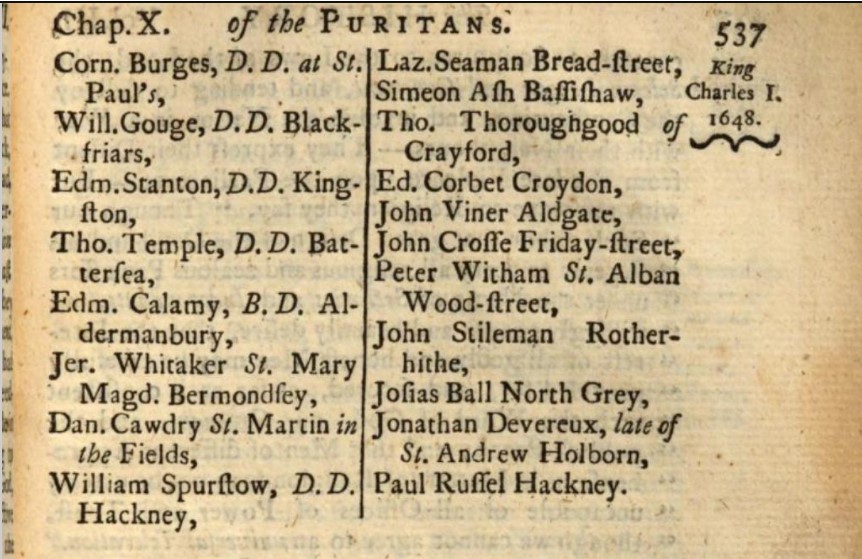
Thorowgood’s diary highlights the shady intrigue surrounding the trial of King Charles I, as agents of Oliver Cromwell tried to build a consensus behind executing the king. We find in the diary that Thorowgood himself was approached to sign the death warrant and to become a regicide. Kate Morton shows this moment in her picture of the trial at Westminster Hall. After King Charles I was found guilty by judge John Bradshaw (‘Barbarous Bradshaw’), Thorowgood put his name to a petition (pictured above) amongst London Presbyterian clergy to try and halt the impending execution of the King.
The cursed Engagement (which in due time I trust shall have its due) followed soone after, which I did ever refuse to take, notwithstanding all persuasions & threats & that cost me deare in more places & wayes than one. It was no meane man but one of Olivers knights that offred me no meane preferment if I would subscribe, but, blessed be God, though I was tempted, they overcame me not. I met a good friend in Westminster Abby going with a great booke to Barbarous Bradshaw,& whose wayes I know he abhorred as much as my selfe; when he saw me amazed, you remember not, he said, the Spanish proverbe, A wise man will have a friend in Hell as well as in Heaven.
Perhaps like his friend, who sought ‘a friend in hell as well as in heaven,’ Thorowgood’s own position, as a Puritan standing up for the King, probably saved his life when King Charles II was restored to the throne in 1660.




No Comments
Add a comment about this page