


The most notable Christmas tradition of the Stuart dynasty was the Christmas masques performed at the Banqueting Hall in Whitehall on the 12th Night (6th January). These were written by playwright Ben Jonson with the sets and costumes designed by Inigo Jones. One of the earliest masques performed at Whitehall was ‘The Masque of Blackness.’ It angered Puritan zealots, who detested both the theatre and Christmas, and highlights for us today 17th-century ideology at the beginnings of the Empire.
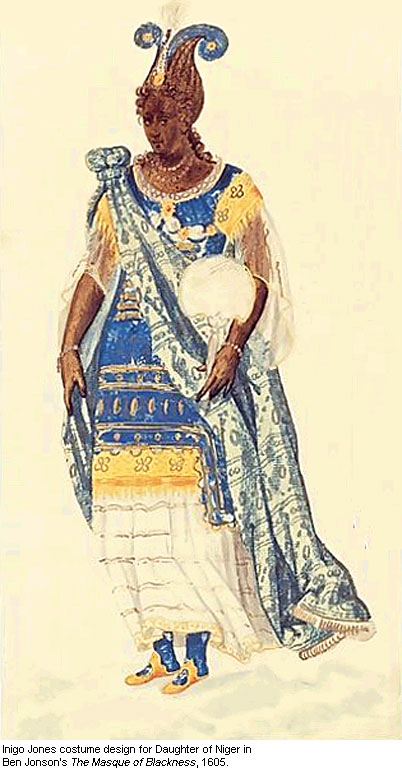
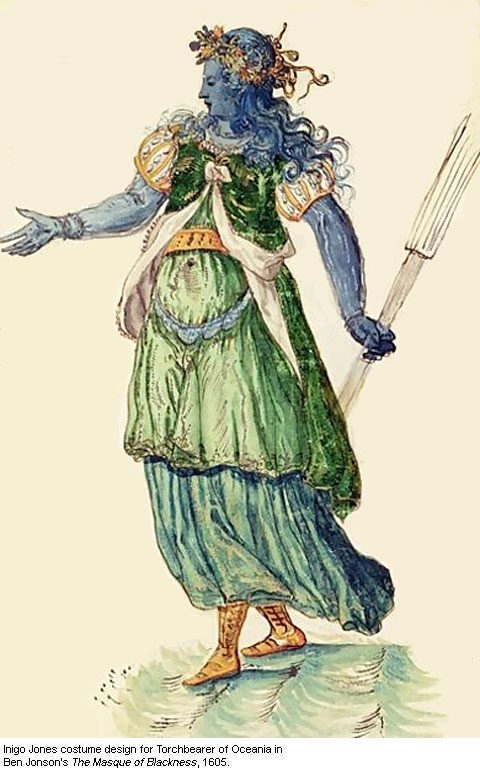
On January 6th, 1605, the celebration of Twelfth Night, lords and ladies gathered to watch as a sea storm brewed in the middle of Whitehall Palace. Six blue-haired mermen danced on a forty-foot mobile stage, surrounded by the crashing of artificial waves. Two Gods, Oceanus and Niger, sat above the storm, each perched on a giant seahorse. And then, rising over the waves, a massive seashell appeared, flanked by a company of sea monsters and torch-bearers; inside were Queen Anne and eleven of her ladies, dressed as African nymphs. The women were dressed extravagantly in blue and silver, each dripping with pearls. However, it was the women’s makeup, not their costumes, that left the most lasting impression on the onlookers; Queen Anne and each of her ladies had their faces covered in black paint.
This performance was The Masque of Blackness, a short play written by poet Ben Jonson at the behest of Queen Anne herself. In the Stuart Court, masques–lavish performances with singing, acting, and elaborate set design–were a popular form of entertainment. In The Masque of Blackness, Niger’s twelve daughters, the nymphs played by Queen Anne and her ladies, bemoan the fact that they are no longer considered beautiful due to their dark complexions, and want to become beautiful again. The Goddess Aethiopia hears their prayers and tells them to seek out a place ending in “-Tania,” leading them finally to Britannia, whose King (described as “a sun…whose beams shine day and night”) has the power to bleach their skin white.
While this message has clearly not aged well, it was also controversial when it was first performed, albeit for different reasons. The sight of white women wearing blackface makeup was as shocking to the seventeenth-century audience as it would be to a modern one, but for the nobles who saw The Masque of Blackness performed in 1605, the concern was one of respectability. As the British Empire expanded, its people came into contact with different cultures and responded by othering these cultures in order to preserve the British sense of superiority. The Masque of Blackness is obviously an attempt to do just that–to reinforce English ideas of white beauty–but this was only one form of otherization. Another form, also widespread during this time, was to stereotype Black people as uncivilized and sexually immoral. Therefore, even though The Masque of Blackness’s message is an unequivocally pro-white one, it was still scandalous due to the perceived impropriety of white English women dressed as Black women.
The issue of the Masque was a small part of a much larger controversy surrounding the Stuart court. Though the conflict was in its infancy at this point, criticisms of the Stuart Court for being immoral, lecherous, and overzealous with spending would eventually become a major theme in the coming English Civil War. The Puritans who would eventually overthrow Charles I complained of the Stuart Court’s frivolous spending, wild parties, and scandalous performances; these habits, according to the Puritan ethos, were part of the larger pattern of Catholic immorality that influenced Charles I to break from Parliament and betray his country. Though the Masque of Blackness was only one controversy which took place years before the war, it provides a clear insight into the growing tensions that led to the English Civil War and the eventual Puritan takeover of the country.


Comments about this page
You have the wrong queen This is Ann of Demark who was married to James I and performed as an African princess in Ben Johnson’s ‘Masque of Darkness’ in 1605.
Just realized the Queen Anne in question was Anne of Denmark, consort of King James I…..
This must have happened on 6th January 1705, as Queen Anne reigned from 1702 to 1714, Was 1605 a typo?
Add a comment about this page